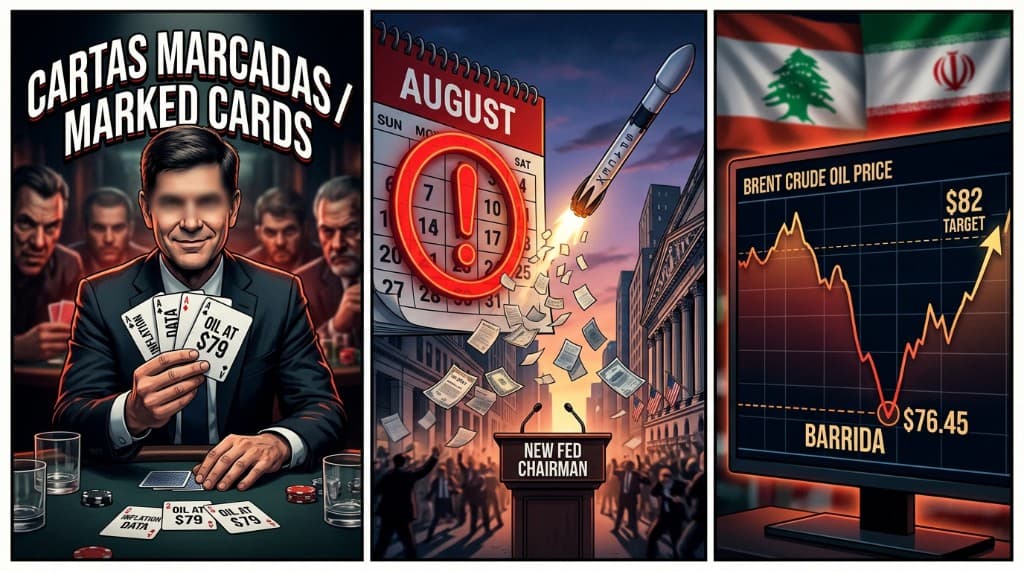
Warsh Is Playing With Marked Cards — And August Is When the Market Finds Out
José Luis Cava argues that Kevin Warsh has a structural advantage in his opening months as Fed chair: inflation at 4% will fall naturally to 3-3.5% by year-end as energy prices normalize, letting Warsh claim success without decisive action. The five working groups he announced are, in Cava's reading, a mechanism to buy approximately two months of time. That window closes in August — when SpaceX begins releasing paper into the market, the statistical probability of a new-Fed-chair correction peaks, and the oil recovery toward $82 adds inflationary noise. The near-term is constructive. August is where discipline pays.
Warsh's structural advantage
Cava opens with a deliberately irreverent reading of Kevin Warsh's position. The new Fed chair — whom Cava refers to throughout as "Kevin Costner" in a nod to the Hollywood actor — has inherited a setup that most central bankers would envy: the hardest work has already been done for him.
Current headline inflation sits at approximately 4%. The primary driver of that elevated reading has been energy prices — the Brent crude spike driven by Middle East conflict. With the US-Iran memorandum signed and Hormuz beginning to normalize, oil prices have declined significantly from their conflict peaks. The natural trajectory of energy disinflation, absent any new shocks, will pull headline inflation toward 3-3.5% by year end without any intervention from the Fed.
Warsh can therefore claim commitment to price stability, point to falling inflation numbers, and avoid the political and market cost of actual rate hikes — all simultaneously. He knows the data will favor him. The cards are marked.
Five working groups: buying time until August
Warsh's announcement of five working groups to modernize the Federal Reserve's analytical infrastructure using real-time data models generated considerable commentary. Cava's reading is more skeptical than most.
The Federal Reserve's historical track record, in Cava's analysis, shows a consistent pattern: the institution has not actually led monetary policy through independent models. It has followed the 2-year Treasury yield — allowing markets to price the policy path, and then catching up. The gap between the Fed's stated sophistication and its actual decision-making methodology is large.
The working groups, in this reading, are not a genuine analytical initiative. They are a mechanism to generate approximately two months of institutional activity — reports, meetings, interim findings — before any real decisions need to be taken. That two-month buffer lands precisely in August and September.
Why August matters: the three convergences
Three factors converge in August that make the summer correction probability elevated:
The statistical pattern of new Fed chairs. Historically, the arrival of a new Federal Reserve president has been followed by a market correction that catches investors by surprise. The mechanism is behavioral rather than fundamental: markets calibrate to the previous chair's communication style and are exposed to uncertainty during the transition. When the new chair's actual approach crystallizes — particularly one who explicitly rejects forward guidance — the adjustment creates volatility.
SpaceX paper begins flowing. The SpaceX IPO on June 12 was the beginning of a process, not its conclusion. The lock-up structure that governs how early investors and insiders can sell their shares begins releasing in August. This creates a supply of new equity entering the market at scale — what Cava calls "papel" — that did not exist before. When large amounts of new paper enter a market that has been supported partly by a scarcity of supply, the mechanical effect is downward pressure on prices broadly.
The mortgage rate political dynamic. Cava offers a reading of Warsh's decision not to raise rates despite 2-year Treasury yields signaling that hikes are warranted: the political priority of keeping long-term yields — and therefore mortgage rates — low for the duration of Trump's electoral positioning. Lower mortgage rates support the housing market narrative. Warsh, in this reading, is not simply an independent technocrat but a participant in a broader political economy. The implication is that the current rate stance may be held artificially low relative to the data, creating a correction risk when the political moment passes.
Oil: the sweep confirmed, target $82 in August
The Brent crude market has executed the technical pattern that Cava identified days ago. On June 16, the day the US-Iran memorandum was signed, Brent dropped intraday to $76.45 — sweeping below the March 10 support level of $79.7, forcing out all long positions and attracting new short sellers. The price then reversed sharply and closed at $79.85. As of June 19, Brent trades at approximately $79.29, confirming the recovery from the sweep low.
The fundamental backdrop for the subsequent move higher comes from two sources. First, the Bank of America fund manager survey shows that professional investors currently "hate" holding oil — positioning has reached an extreme of bearishness that historically precedes recoveries. Second, and more immediately: the peace negotiations between the United States and Iran have been complicated by Israeli military action in Lebanon. With that variable reintroduced, the full normalization of Middle East supply that markets had priced in is delayed. The geopolitical risk premium does not disappear — it merely retreats from its peak.
Brent at $79.29, having completed the sweep and begun recovery, now targets the $82 zone before the August correction fully plays out.
The near-term and the medium-term
The picture Cava paints for the next eight to ten weeks has two distinct phases. In the near term — through July — the market is likely to remain constructive. Warsh's working groups create institutional calm, energy disinflation is progressing, and the SpaceX paper has not yet reached the market in volume. Equity markets can continue trending upward from current levels.
August shifts the picture. The convergence of SpaceX supply, the statistical new-chair correction window, and the potential for oil to reassert inflationary noise creates the conditions for the sharp correction that Cava has been forecasting as the primary buying opportunity of the cycle. Patient investors who have preserved capital — rather than chasing the final weeks of the pre-correction rally — will be positioned to deploy at significantly better prices.
The message is consistent with what it has been since May: do not chase. The opportunity is in front of us, not behind us.
Analysis based on José Luis Cava video published June 19, 2026. For informational purposes only — not financial advice.
Explore the data
Check the latest congressional trades and active investment signals.