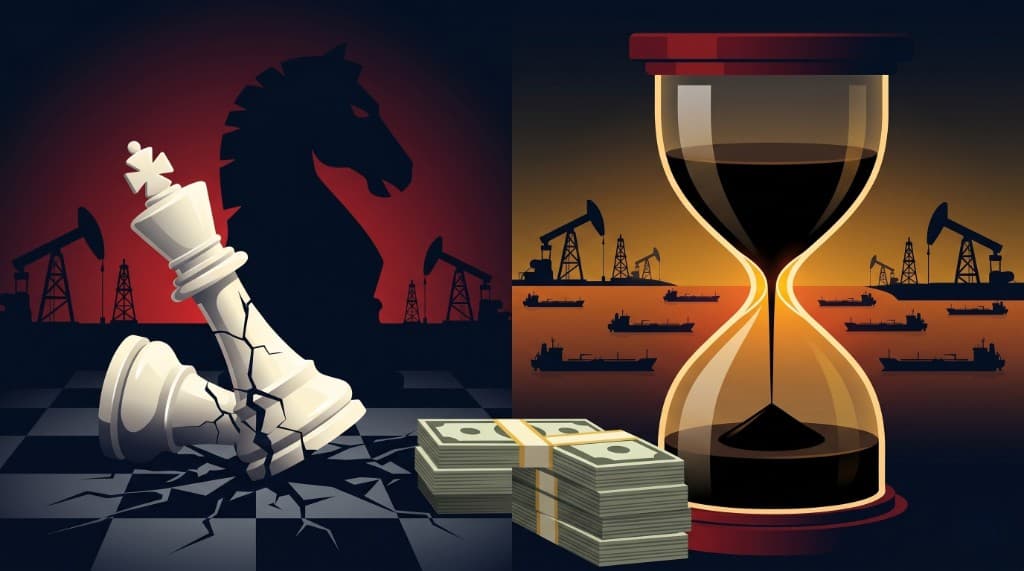
Why the US and Israel Eliminated Iran's Moderates — and What It Means for Oil in the Next 10 Days
Cava reveals the strategic logic behind the assassination of Iran's moderate leaders: by empowering the radical Revolutionary Guard faction, the US and Israel ensure that peace remains elusive — and profitable. With the Strait of Hormuz blocked, Iran has 10-15 days of fuel reserves left before its oil infrastructure suffers permanent damage. The endgame isn't military — it's financial. A deal with the radicals is the only path forward, and it will reshape oil markets, Gulf politics, and investor positioning for months.
The assassination of peace
This is one of Cava's most geopolitically charged analyses — and one of the most important for understanding where oil and markets go next.
The central thesis: the US and Israel deliberately eliminated Iran's moderate leaders — the faction that was open to negotiation and peace. By doing so, they handed power to the most radical wing of the Revolutionary Guard, a faction that opposes any agreement.
Why would you kill the people willing to negotiate?
Because peace is not the goal. Control is.
Who benefits from chaos?
The US
- Energy companies profit from volatile oil prices and access to reconstruction contracts
- Venezuela reconstruction projects give the US alternative oil sources, reducing urgency for a Middle East deal
- The dollar strengthens when the US controls energy chokepoints (as Cava explained in previous videos)
- Employment and consumption data remain strong, meaning the domestic economy can absorb geopolitical tension without damage
Israel
- Regional instability justifies continued military spending and strategic positioning
- A weakened, internally divided Iran is less threatening than a unified, recovering one
The Revolutionary Guard's radical wing
- Paradoxically, the extremists also benefit from tension — it justifies their existence, their control over Iran's economy (oil, bitcoin mining), and their grip on power
- Peace would mean accountability, transparency, and loss of influence
The Strait of Hormuz: a 10-day countdown
Here's where it gets urgent for markets:
The US is actively blocking the Strait of Hormuz — Iran's only route for oil exports and fuel imports. Cava estimates Iran has 10-15 days of fuel reserves before critical consequences:
- Refineries shut down without crude imports and processing capacity
- Oil wells suffer permanent damage if production stops for extended periods (you can't just turn them back on)
- Domestic fuel shortages accelerate the already dire economic crisis (60-70% inflation, 20% GDP loss from war)
This isn't a slow squeeze — it's a hard deadline. And the clock is ticking.
The only exit: buy the radicals
Cava dismisses military solutions. The US won't invade, and Israel can't sustain a ground war in Iran. The endgame is financial:
The radical faction will be offered a financial settlement — enough money to make peace more profitable than war.
This is how it's always worked. The question isn't if but how much and when. The 10-15 day fuel deadline creates enormous pressure for a deal in early May 2026.
What this means for oil
The oil market is caught between two forces:
Bearish pressure:
- A deal would lift sanctions, flood the market with Iranian crude, and push prices lower
- Alternative routes (Iraq, Gulf pipelines) are already circumventing Hormuz, weakening Iran's leverage
Bullish pressure:
- If talks fail and fuel runs out, Iranian production takes permanent damage — removing supply from the market for years
- Regional instability premium stays elevated as long as Hormuz is contested
Our read: The deal happens. It's a matter of weeks, not months. When it does, expect an initial oil price dip (supply expectations increase) followed by a longer stabilization period as reconstruction absorbs both capital and crude.
China: the silent loser
Cava continues to emphasize that China is the biggest geopolitical loser in this conflict:
- Energy routes disrupted (Hormuz controls their oil lifeline)
- Allies weakened (Iran, Venezuela)
- The yuan can't replace the dollar as reserve currency due to capital controls
- Industrial subsidies create short-term competitiveness but long-term dependency
For investors, this reinforces the case for US-centric tech and AI positions over Chinese exposure.
This analysis is based on Cava's geopolitical commentary from April 22, 2026. For informational purposes only — not financial advice.
Explore the data
Check the latest congressional trades and active investment signals.