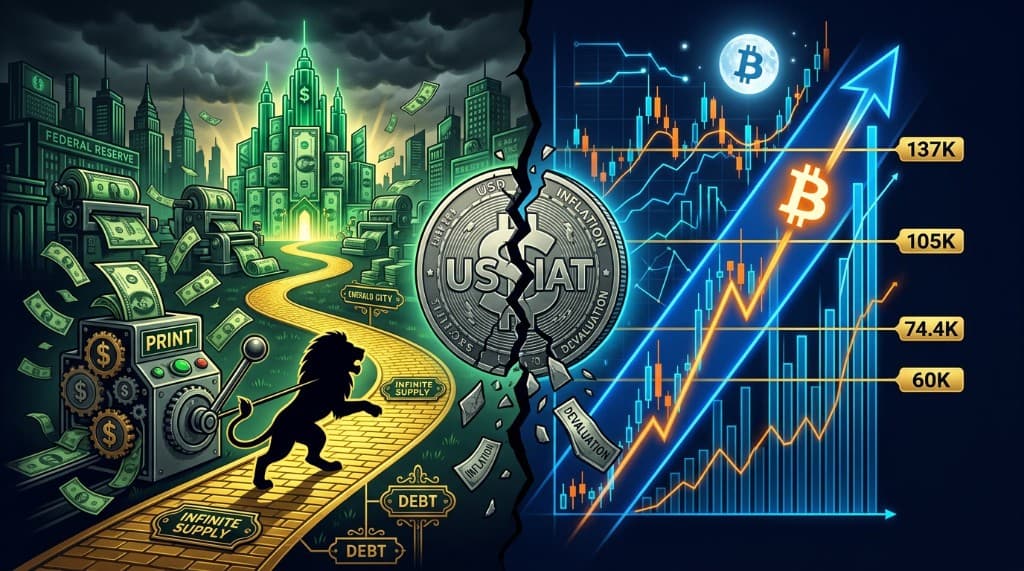
The Wizard of Oz Was About Money All Along — And Bitcoin Is the Answer
L. Frank Baum's Wizard of Oz was never a children's story. It was a monetary allegory about the gold standard, fiat money, and the politicians who learned to print their way to power. José Luis Cava connects the 1900 parable to 2026, explains why Bitcoin is the logical defense against monetary degradation, shares a tax-efficient strategy using two ETNs, and maps the technical case for targets at 105,000 and 137,000 dollars.
The story you were told was not the real story
L. Frank Baum published The Wonderful Wizard of Oz in 1900, at the height of the debate over the American monetary system. Cava's analysis reveals what most readers never discover: the book is a precise economic allegory, and every element carries a specific meaning.
"Oz" is not a fantasy name. It is the abbreviation of ounce troy — the standard unit of measurement for precious metals. The entire story takes place inside a metaphor about gold.
The yellow brick road represents gold bars — the path that everyone follows in search of prosperity, but which leads only to an illusion.
The characters map directly to the economic classes suffering under the monetary policies of 1900:
- The Scarecrow is the agricultural sector, struggling under falling commodity prices that made farming economically unsustainable.
- The Tin Man is the industrial worker, whose wages were being eroded by deflation and whose livelihood depended on a monetary system he did not control.
- The Cowardly Lion is the populist politician — specifically William Jennings Bryan and the bimetallist movement. The bimetallists wanted to add silver to the gold standard precisely because silver was more abundant, which would allow more money to be printed, which would allow more promises to be made to voters.
- The Wizard is the center of financial and political power — the establishment behind the curtain, projecting the illusion of control while the real mechanics operate out of sight.
The twist that Baum did not write — but we are living
In the original story, the Wizard is eventually exposed as a fraud, and the protagonists discover their own power.
In the 2026 version, Cava argues, the Cowardly Lion has taken the printing machine. The politicians who once begged for the ability to create money have seized it entirely. The result is systematic monetary degradation — a progressive devaluation of purchasing power that falls disproportionately on those who work for wages, save in cash, or are entering the economy for the first time. Young people in particular inherit a system in which the currency they earn depreciates faster than they can accumulate it.
Bitcoin, in this reading, is not a speculative asset. It is a structural defense against fiat money that has been captured by political incentives. Its fixed supply — mathematically enforced, not dependent on any government's willingness to exercise restraint — is precisely what makes it the opposite of the Cowardly Lion's printing machine.
The tax-efficient strategy: IBTC and WBTC
For investors who want Bitcoin exposure without holding the asset directly, Cava recommends ETNs — Exchange Traded Notes — financial instruments backed one-to-one by the underlying cryptocurrency. Unlike futures-based products, ETNs track spot Bitcoin price without roll costs or tracking error from contract rollovers.
His specific recommendation involves two instruments:
- IBTC: preferred for its high trading volume and liquidity — easier to enter and exit large positions without significant price impact.
- WBTC: preferred for its lower ongoing fees — better for holding positions over longer periods where the fee differential compounds.
The strategic use of both instruments unlocks a tax optimization that is particularly relevant for Spanish investors:
Under Spanish tax law, if you sell an asset at a loss and repurchase the same asset within two months, the loss cannot be used to offset gains in your tax return — the deduction is disallowed. However, if you sell IBTC at a loss and immediately buy WBTC — or vice versa — you maintain full Bitcoin price exposure without interruption, while the fiscal loss on the sold instrument is legally recognized and can reduce your taxable base.
This is not a loophole. It is tax planning using instruments that are economically equivalent but legally distinct. The result: you stay long Bitcoin through any correction, and the corrections generate deductible losses that reduce your total tax burden.
The technical case: reading the footprint of institutional money
Cava's technical analysis focuses on one concept above all: distinguishing between what strong hands (institutions) do and what weak hands (retail investors) do. The difference is almost always visible in price and volume data, if you know what to look for.
The key support that was broken deliberately: $74,420. Cava identified this level as critical before it was breached. His reading: institutions engineered the break below this level intentionally, driving price toward $60,000 to trigger stop-loss orders and panic selling from retail investors. When weak hands sell at the worst possible moment, strong hands absorb those positions at maximum discount.
This maneuver — known in technical analysis as a "stop hunt" or "barrida" — is not a market failure. It is the market functioning exactly as it does when large capital is accumulating.
Volume by price level: Rather than looking at daily trading volume, Cava analyzes how much trading occurred at each price level — essentially a profile of where market participants have been most active. The peak of this activity was at $67,100. When price broke below this level, it forced the majority of market participants who had entered around that level to either take losses or capitulate. Once that capitulation was complete, the path upward was cleared.
The directional line: Drawing a line connecting the major volume accumulation zones — the $20,000 floor from the previous cycle and the $67,100 high-volume node — Cava projects a long-term ascending channel that defines the structural trajectory of Bitcoin.
Price targets: 105,000 and 137,000 dollars
Based on the channel projection and parallel lines drawn through the 2021 and 2025 cycle highs, Cava identifies two targets:
First target: $105,000 — the upper boundary of the primary ascending channel derived from the long-term directional line.
Second target: $137,000 — derived from the parallel channel drawn through the 2021 and 2025 highs, representing the extension of the multi-cycle structure.
The current movement, in his assessment, is a textbook correction within a structurally intact bull trend. The stop hunt at $74,420, the capitulation at $67,100, the accumulation near $60,000 — these are the fingerprints of institutional positioning, not the beginning of a structural reversal.
The recommendation: do not follow social media panic. Follow the money. The institutions bought the fear. The targets are $105,000 and $137,000.
Analysis based on a José Luis Cava video published May 21, 2026. For informational purposes only — not financial advice.
Explore the data
Check the latest congressional trades and active investment signals.