Institutions Are Buying Everything — UAE Exits OPEC — and China Is Hoarding Oil for a Reason Nobody Wants to Talk About
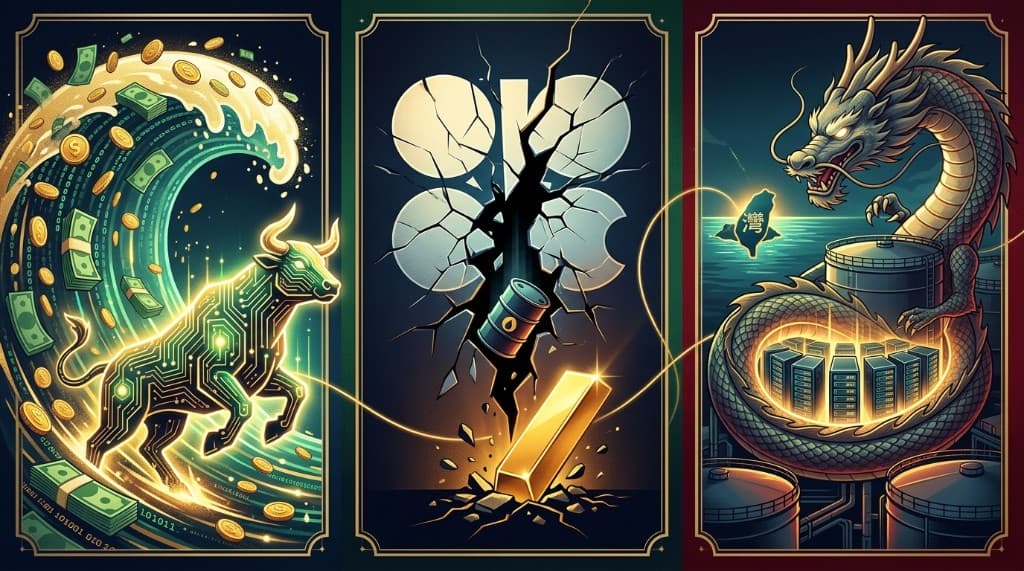
Cava reveals three converging forces reshaping markets. First: institutional investors are pouring record-breaking amounts into global equities — especially tech and AI — betting on massive liquidity injections and accelerated profit growth in 2026-2027. Second: the UAE has left OPEC, a geopolitical earthquake linked to Gulf tensions and Kuwait's expanded production capacity, which will likely flood the market with oil and push gold higher. Third: China is buying oil at record prices — not to profit, but to build strategic reserves for energy independence ahead of potential military action on Taiwan and to power its AI infrastructure. The world's biggest players are positioning for something massive.
Record inflows: institutions are all-in on tech
The smart money isn't just bullish — it's aggressively deploying capital at a pace not seen in years.
Global equity funds are receiving record-breaking inflows, with institutional investors — pension funds, sovereign wealth funds, hedge funds — concentrating their bets on:
- Technology stocks — the AI infrastructure buildout is accelerating
- US equities — dollar dominance and the deepest capital markets in the world
- Growth over value — the bet is on future earnings, not current fundamentals
Why now?
Institutions are front-running two catalysts:
- Major liquidity injections expected — whether through Fed rate cuts, Treasury operations, or stealth QE via swap lines, more dollars are coming into the system
- Accelerated corporate profit growth in 2026-2027 — AI adoption is moving from experimental to revenue-generating across industries
This is significant because institutional investors don't make emotional bets. When they move this aggressively into equities, they're acting on models, data, and — as Cava has repeatedly noted — sometimes privileged information about upcoming policy moves.
When institutions buy this aggressively, they're not guessing. They know something about the liquidity pipeline that retail doesn't.
The contrarian concern: when everyone is positioned the same way, the correction — when it comes — will be sharp. But the medium-term direction is clear: institutions are betting on tech and AI to drive the next leg up.
UAE leaves OPEC: a geopolitical earthquake
This is a massive development that most media is underplaying.
The UAE has officially exited OPEC. This isn't a routine disagreement about production quotas — it's a geopolitical realignment tied to:
The Gulf power shift
- Kuwait has expanded its oil production capacity significantly, changing the balance of power within OPEC
- The UAE, already strained by the hidden liquidity crisis we covered earlier, is breaking free from production constraints
- Regional tensions between Gulf states are intensifying beneath the surface
What this means for oil
Without UAE production caps, more oil flows to market. Combined with Kuwait's expansion:
- Short-term: Oil supply increases → prices drop
- Medium-term: OPEC's ability to control prices weakens dramatically without one of its largest producers
- Long-term: The cartel's relevance diminishes further, replaced by bilateral deals and geopolitical arrangements
The gold connection
Cava connects the dots: when oil prices drop, the dollar typically strengthens. But this time, the drop comes from geopolitical fracturing, not demand weakness. The uncertainty premium shifts from oil to gold:
- Oil drops → less inflation pressure → rate cuts more likely → gold rises
- OPEC fracturing → geopolitical uncertainty → safe haven demand → gold rises
Both paths lead to higher gold prices.
China's oil stockpile: the Taiwan connection
This is the most alarming point in the analysis.
China is buying oil at record-high prices. This makes zero financial sense if the goal is to profit from price movements. Cava explains why they're doing it:
Energy independence as a strategic weapon
China is building massive strategic petroleum reserves for three reasons:
1. AI infrastructure demands energy The AI race requires enormous amounts of electricity. Data centers, chip fabrication, training runs — all energy-intensive. China knows that controlling its energy supply is as critical as controlling its chip supply. If it depends on imported oil through vulnerable routes (like the Strait of Hormuz), any geopolitical disruption cripples its AI ambitions.
2. Taiwan contingency planning This is the elephant in the room. If China moves on Taiwan — whether through military action, blockade, or economic coercion — the West will almost certainly impose oil sanctions similar to what happened with Russia. China needs years of reserves to survive that scenario.
By stockpiling now at high prices, China is essentially paying an insurance premium. The cost of oil at $104/barrel is irrelevant if the alternative is complete energy dependency during a Taiwan crisis.
3. Strait of Hormuz vulnerability As we've covered extensively, the US controls the Strait of Hormuz. China gets a significant portion of its oil through this chokepoint. Every barrel stored domestically is a barrel that doesn't need to pass through American-controlled waters.
The timeline question
Cava doesn't speculate on exact dates, but the scale of China's stockpiling suggests they're preparing for a scenario within the next 2-5 years. The urgency of the accumulation — buying at peak prices — suggests the timeline may be shorter than most analysts expect.
The three forces converge
Step back and see the full picture:
- Institutions buying tech aggressively → They expect AI to be the dominant growth driver, and they expect the liquidity to keep flowing
- UAE leaving OPEC → Oil supply increases, OPEC weakens, gold benefits from uncertainty
- China hoarding oil → Preparing for a scenario where energy supply is weaponized against them
All three point to the same conclusion: the world's biggest players are positioning for a massive shift in the global order. AI is the prize, energy is the weapon, and liquidity is the fuel.
For investors, the message is clear: technology and gold are the two sides of this trade. Tech captures the growth from AI adoption. Gold captures the uncertainty from geopolitical realignment. Both belong in a long-term portfolio.
This analysis is based on Cava's market commentary from April 29, 2026. For informational purposes only — not financial advice.
Explore the data
Check the latest congressional trades and active investment signals.