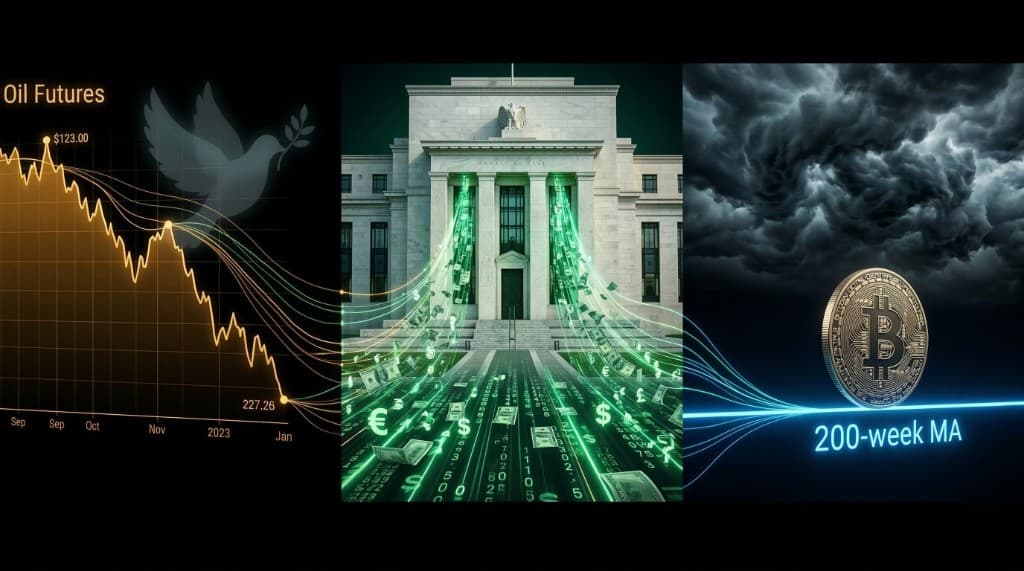
Oil Futures Are Betting on Peace, the Fed Will Print, and Bitcoin Holds the Line
Futures markets expect oil back at $85 within weeks as conflict tensions ease. The Fed is preparing to flood the system with liquidity. Gold surges on safe-haven demand. And Bitcoin refuses to break below its 200-week moving average — a historically bulletproof floor.
The futures market is calling the bluff
While headlines scream about $90+ oil and energy Armageddon, the futures market is telling a completely different story.
Oil futures contracts are showing a negative slope — meaning traders who are putting real money on the line expect oil prices to decline over the coming weeks, not rise. The consensus target: around $85 per barrel, down from current elevated levels.
Why? Two converging forces:
Supply is coming back
- Saudi Arabia is increasing oil exports through a key pipeline, bypassing the Hormuz bottleneck entirely
- The US is lifting sanctions on Russian oil — a move that would bring significant Russian supply back to global markets
- Combined, these two sources alone can offset much of the Hormuz disruption
Geopolitics favor de-escalation
- Iran depends on Russian wheat imports — Moscow has leverage to push Tehran toward negotiation rather than prolonged confrontation
- Iran's oil revenue, which flows through Hormuz-adjacent routes, is being strangled — the longer the standoff continues, the more Iran loses
- Futures are pricing in conflict resolution within 2-4 weeks, not an indefinite blockade
Futures traders don't trade hope — they trade probability with real money. When the curve slopes downward, the market is betting on resolution, not escalation.
This aligns with what we've been analyzing: the Hormuz situation was strategic, not chaotic. A controlled disruption has a controlled ending. The futures market appears to agree.
Gold: the safe haven that never lies
While oil futures point to de-escalation, gold continues to climb. This isn't a contradiction — it's complementary information:
- Chinese central bank purchases continue at an aggressive pace, building reserves independent of dollar-denominated assets
- Institutional safe-haven demand is elevated as portfolio managers hedge against tail risks even as base cases remain constructive
- Gold thrives in the current environment of monetary expansion + geopolitical uncertainty, regardless of whether oil drops
Gold's strength doesn't mean markets expect disaster. It means smart money is buying insurance while the premium is justified. When the geopolitical risk fades, gold may consolidate — but the structural bid from central bank diversification away from dollar reserves provides a long-term floor.
The Fed's hand is forced
Perhaps the most consequential development for markets isn't geopolitical — it's monetary. The Federal Reserve is expected to shift toward expansionary policy, and the reasoning is straightforward:
- Military spending is surging — the US-Israel operations against Iran require immediate funding, and the Department of Defense needs liquidity
- The financial system needs support — stress in private credit markets (more on this below) requires the Fed to keep conditions loose
- Inflation from oil is expected to be temporary — if futures are right and oil returns to ~$85, the inflation spike to around 5% would be short-lived
This is the pattern we've described before: the post-1971 debt machine requires perpetual monetary expansion. Geopolitical crises don't break this pattern — they accelerate it. War spending means more borrowing, which means more Fed liquidity, which means asset prices are supported.
For investors, this is the critical takeaway: the Fed will choose inflation over financial crisis, every single time. That means owning assets (equities, gold, Bitcoin, real estate) remains the correct positioning.
Private credit: the crack in the wall
The one area showing genuine stress is private credit markets, and one name in particular has brought this into focus: Apollo Global Management.
Here's what's happening:
- Apollo has been forced to devalue assets in its loan portfolio, particularly in the software sector where credit conditions have deteriorated sharply
- The company's stock price has dropped significantly as investors reassess the quality of its private lending book
- This echoes the broader software sector credit stress we covered weeks ago
The concern isn't Apollo specifically — it's what Apollo represents. Private credit (shadow banking) has grown enormously in recent years, filling the gap left by regulated banks that pulled back from risky lending after 2008. If private credit portfolios are deteriorating:
- Redemption pressure could force fire sales of illiquid assets
- Contagion could spread to other private credit firms holding similar positions
- The Fed may need to intervene more aggressively to prevent a credit event
When Apollo — one of the most sophisticated credit firms on the planet — starts marking down assets, it's not a one-off. It's an early warning for the entire private credit ecosystem.
That said, the key market indicators suggest this remains contained, not systemic:
- Junk bond risk premiums have widened but aren't in crisis territory
- Corporate bond spreads show stress, not panic
- The SP500 continues to hold, indicating equity markets don't see broad contagion
Bitcoin: the 200-week floor holds
In the middle of geopolitical chaos, oil volatility, and credit market stress, Bitcoin is doing something remarkable: holding above its 200-week exponential moving average.
This level has historically been Bitcoin's ultimate support — a floor that has held through every major correction since 2015. The fact that it's holding now, despite:
- Forced selling from software firms needing liquidity
- General risk-off sentiment from the Iran conflict
- Elevated volatility across all asset classes
...is a powerful signal of underlying demand.
The technical picture suggests a potential move toward $90,000-$95,000 if:
- The 50-week moving average provides additional support
- Institutional accumulation continues (ETF flows remain positive)
- Bearish sentiment fades as geopolitical resolution approaches
Bitcoin's resilience in this environment reinforces its evolving role as what we've called a strategic reserve asset — not a speculative toy, but a serious allocation in institutional portfolios.
Putting it all together
The picture that emerges from these two analyses is remarkably coherent:
- Short-term: oil drops toward $85 as supply increases and conflict de-escalates (2-4 week horizon)
- Medium-term: the Fed injects liquidity to support military spending and prevent credit market stress from spreading
- Long-term: the debt-expansion cycle accelerates, benefiting hard assets (gold, Bitcoin) and broad equity indices (SP500)
The risks to watch:
- Private credit contagion — if more firms beyond Apollo show distress, the Fed's response will need to be larger and faster
- Oil above $100 sustained — would invalidate the "temporary inflation" thesis and force the Fed into a difficult corner
- Futures curve flattening — if the negative slope disappears, it means the market no longer expects near-term resolution
For now, the base case remains: controlled disruption, managed resolution, and more liquidity coming. That's the environment where risk assets perform.
This analysis is based on macroeconomic commentary by José Luis Cava (HOPLA Finance). CongressFlows synthesizes publicly available market analysis to help investors contextualize congressional trading data. This is not financial advice.
Explore the data
Check the latest congressional trades and active investment signals.