Gold Falls While China Hoards It, Blanchard Says Oil to $200, and 50% of Investors Are Bearish — Time to Buy?
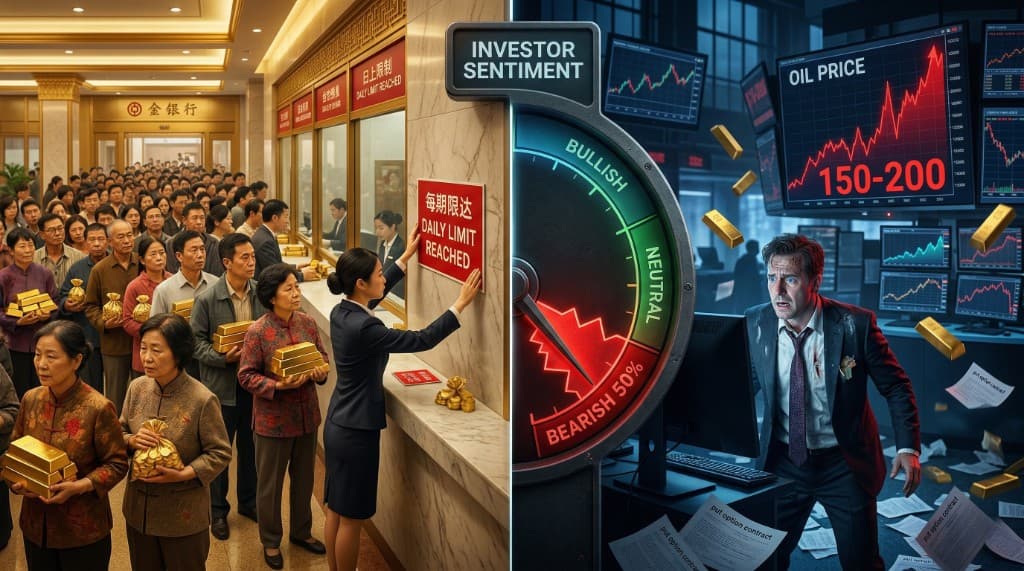
The gold paradox deepens: prices fall while Chinese citizens queue to buy physical gold. Funds are dumping gold to cover oil losses. Blanchard's $150-$200 oil forecast terrifies fund managers into maximum hedging. And with 50% bearish sentiment, history says we're closer to a bottom than a crash.
The gold paradox, part two
In our previous analysis, we explained why gold falling during an inflation scare isn't a contradiction — markets were pricing in temporary inflation. But the picture has become even more interesting.
Gold isn't just falling because of inflation expectations. It's falling because of forced selling from two very different sources:
Funds covering oil losses
Large speculative funds that had short positions on oil futures have been crushed by the ~35% energy price surge. When a fund loses money on one position, it needs to raise cash by selling other assets. Gold — liquid, easily sold, and held in large quantities by these funds — becomes the ATM for covering oil losses.
This is the mechanics of a cross-asset liquidation:
- Fund shorts oil → oil spikes → massive losses
- Fund needs cash to meet margin calls
- Fund sells gold positions to raise liquidity
- Gold price drops despite fundamentally bullish conditions
Gulf states selling for war financing
Countries in the Gulf region are liquidating gold reserves to fund wartime expenditures. When a sovereign wealth fund sells hundreds of millions in gold, it moves the market — regardless of what inflation is doing.
Gold isn't falling because the world is safer. It's falling because the people who own it need cash for other emergencies. That's not a bearish signal — it's a buying opportunity hiding in plain sight.
The key insight: gold's price decline is driven by liquidity mechanics, not by a change in its fundamental value proposition. When the forced selling exhausts itself — when funds finish covering oil losses and Gulf states stabilize their war budgets — gold snaps back.
China's citizens don't trust their government — so they buy gold
While institutional gold is being liquidated, something extraordinary is happening at street level in China: ordinary citizens are buying physical gold in record quantities.
The demand is so intense that Chinese banks have self-imposed daily purchase limits — not because of government mandate, but because the logistics of handling, storing, and insuring that volume of physical gold are overwhelming their operations.
Why are Chinese citizens hoarding gold?
- Deep distrust in the financial system — memories of real estate collapses (Evergrande, Country Garden) and bank deposit freezes are fresh
- Distrust in the government — capital controls, surveillance, and arbitrary policy changes make citizens seek assets that can't be confiscated or frozen digitally
- Currency devaluation fear — the yuan's long-term trajectory against hard assets is a genuine concern for middle-class savers
- Cultural affinity — gold has been the savings vehicle of choice in Chinese culture for millennia, and that instinct intensifies during uncertainty
This creates a fascinating divergence: institutional players dump gold for liquidity while retail China absorbs physical supply at a ferocious pace. When the institutional selling stops, the persistent retail demand from 1.4 billion people becomes the dominant force — and that's bullish.
Blanchard's $150-$200 oil forecast
Olivier Blanchard — former chief economist of the IMF and one of the most respected macroeconomists alive — has publicly forecast that oil could reach $150-$200 per barrel if the conflict extends.
Whether or not this forecast is accurate, its impact on market behavior is immediate and measurable:
Fund managers are terrified
Blanchard's name carries weight. When he speaks, institutional capital listens. The response has been a massive increase in put option buying — fund managers are paying up for downside protection at a rate that suggests deep anxiety about their portfolios.
The fear is quantifiable
- Put option volumes on major indices have spiked
- The cost of protection (put premiums) is elevated across equities and credit
- Fund surveys show maximum hedging levels — managers are spending heavily to insure against a crash
But Blanchard's forecast requires specific conditions
$150-$200 oil requires:
- The Strait of Hormuz to remain effectively closed for months
- No negotiated resolution or alternative supply routes
- OPEC to not increase production to capture market share
- US strategic petroleum reserves to not be deployed
Each of these assumptions can be challenged. As we've covered, futures markets are pricing in resolution within weeks and the closure was strategic, not chaotic. Blanchard's scenario is possible but not the base case.
50% bearish: the contrarian signal
Now for the data point that matters most for portfolio positioning: 50% of individual investors are bearish, and fund managers are at maximum hedging levels.
Why is extreme bearishness potentially bullish?
The sentiment cycle
Markets are a voting machine in the short term and a weighing machine in the long term. When sentiment reaches extremes:
- Maximum bullishness → everyone who wants to buy already has. No more buyers. Market tops.
- Maximum bearishness → everyone who wants to sell already has. No more sellers. Market bottoms.
At 50% bearish, we're approaching the kind of sentiment readings that historically have marked bottoms, not tops.
Historical pattern
Every major market bottom in recent history was accompanied by extreme bearish sentiment:
- March 2020: maximum fear → massive rally followed
- October 2022: peak bearishness → bull market began
- October 2023: sentiment washout → SP500 rallied 25%+
The 200-day moving average
The SP500 is approaching its 200-day moving average — a level that has historically acted as strong support during corrections within bull markets. When extreme bearish sentiment meets a key technical support level, the setup for a rebound is textbook.
When 50% of investors are bearish and the SP500 hits its 200-day moving average, history doesn't guarantee a bounce — but it's been right more often than the crowd.
The mechanics of fear
What's happening in markets right now is a self-reinforcing fear cycle that creates its own resolution:
- Blanchard forecasts $200 oil → fear increases
- Fund managers buy puts → premiums rise → VIX increases
- Rising VIX triggers algorithmic selling → prices drop
- Dropping prices increase bearish sentiment → more put buying
- Eventually, everyone who's going to sell has sold → selling exhausts itself
- Any positive catalyst (ceasefire talk, oil price drop, Fed action) triggers a violent reversal as short-covering and put-unwinding amplify the move upward
This is why the most powerful rallies happen from maximum fear — the reversal has mechanical fuel from the unwinding of all the hedges and short positions that were put on during the fear phase.
Connecting it all
The picture for March 2026:
- Gold: falling on forced selling (fund liquidation + Gulf sovereign sales), but Chinese retail demand creates a floor. The snap-back when institutional selling exhausts could be sharp.
- Oil: Blanchard's $150-$200 is the fear scenario, not the base case. Futures still price resolution. But the forecast itself is driving hedging behavior that creates short-term volatility.
- Equities: 50% bearish sentiment + 200-day moving average support + maximum hedging = textbook contrarian buy setup. The risk is that the conflict extends beyond what futures price in.
- The Fed: already printing. Liquidity injections + defense spending = expansionary conditions that eventually lift all boats.
What to watch
- Gold ETF flows vs. Shanghai Gold Exchange physical demand — divergence between institutional selling and Chinese retail buying is the key dynamic
- AAII sentiment survey — bearish readings above 50% have historically been strong contrarian buy signals
- SP500 vs. 200-day moving average — a bounce from this level with high volume would confirm the contrarian thesis
- Oil options open interest — declining put volumes would signal that the fear cycle is exhausting itself
- Blanchard follow-up commentary — any softening of his oil forecast would remove a significant source of market anxiety
This analysis is based on macroeconomic commentary by José Luis Cava (HOPLA Finance). CongressFlows synthesizes publicly available market analysis to help investors contextualize congressional trading data. This is not financial advice.
Explore the data
Check the latest congressional trades and active investment signals.