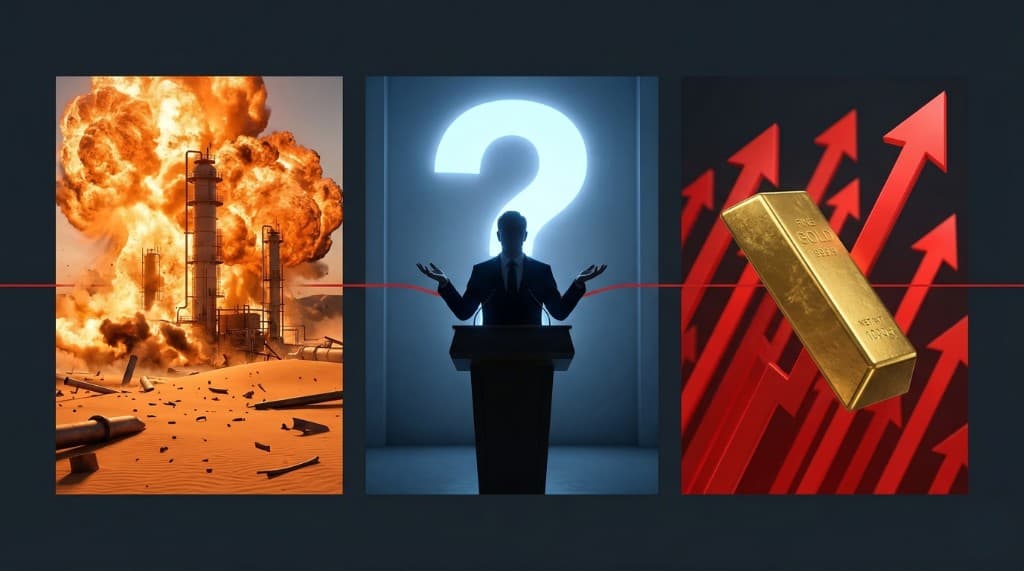
Israel Bombs Iran's Gas, Powell Admits He Doesn't Know, and Gold Falls — None of It Makes Sense Until It Does
Why would Israel destroy Iran's gas infrastructure instead of its nuclear sites? Why does gold fall when inflation fears rise? And what's hiding in the opaque private credit market? Three paradoxes and a K-shaped economy that reveal the same truth: this conflict is about energy control, and the Fed will print whatever it takes.
Why bomb the gas, not the nukes?
Israel's decision to target Iran's major gas infrastructure rather than its nuclear facilities is the kind of strategic choice that only makes sense when you zoom out from the headlines.
The conventional expectation was that any Israeli strike would focus on nuclear enrichment sites — the existential threat that Israel has warned about for decades. Instead, the strikes targeted gas reserves and processing facilities. Why?
The answer is geopolitical, not military:
- Destroying Iran's gas capacity forces Gulf states to choose sides. Iran was positioning itself as a regional gas supplier competing with Qatar and Saudi Arabia. With Iran's infrastructure damaged, Gulf states depend even more on their own production — and on the US military umbrella that protects their exports
- It serves US energy interests directly. Less Iranian gas on the market means higher demand for US LNG exports — exactly the strategic outcome Washington has been engineering
- It's more effective than hitting nuclear sites. Nuclear facilities are deep underground, heavily fortified, and an attack would trigger massive international backlash. Gas infrastructure is above ground, economically devastating, and the diplomatic fallout is manageable
The strike wasn't about Iran's nuclear program. It was about reshaping the regional energy map in favor of US-aligned producers.
Israel didn't bomb Iran's future weapon. It bombed Iran's present economy. That tells you everything about what this conflict is really about.
Private credit: the cracks are spreading
The stress in private credit markets is no longer confined to a single sector. What started as a software-specific problem with firms like Apollo is now showing signs of broader contagion.
The core issue is opacity. Unlike public markets where prices are transparent and updated in real time, private credit operates in the shadows:
- No daily mark-to-market — fund managers decide when and how to value their own assets
- Liquidity mismatches — investors expect to withdraw money on short notice, but the underlying loans are locked up for years
- Cascading redemption pressure — when one fund restricts withdrawals, investors in similar funds rush to get out before they're locked in too
The military conflict is accelerating this stress. Companies that were already struggling with credit access now face higher energy costs, supply chain disruptions, and declining revenues. The loans backing private credit portfolios are deteriorating in quality just as investors demand their money back.
This is the scenario the Fed is most afraid of — and the primary reason Powell is signaling accommodation. A private credit crisis would be 2008-lite: opaque instruments, concentrated losses, and systemic risk hiding in places regulators can't easily see.
The K-shaped economy nobody talks about
Beneath the surface of "strong economic data," the US labor market tells a more nuanced story. The economy is splitting into two realities:
The top half
- Higher-income workers remain employed, receiving wage increases
- Their consumption sustains GDP growth and corporate revenues
- Asset prices (homes, stocks) continue rising, reinforcing their wealth
The bottom half
- Lower-income workers are exiting the labor market entirely — not appearing in unemployment statistics because they've stopped looking
- Job losses are spreading across multiple sectors
- The paradox: average wage growth looks strong because the people pulling the average down have left the dataset
Average wages are rising — but not because workers are earning more. It's because the lowest earners have disappeared from the statistics. That's not strength. That's a statistical illusion masking real pain.
This K-shaped dynamic matters for investors because it means:
- Corporate profits can grow 15% short-term as consumption from the upper half remains strong
- But the foundation is fragile — if the conflict extends and energy costs erode spending power even for higher earners, the whole structure wobbles
- The Fed sees this — it's another reason the monetary response will be expansionary rather than restrictive
Powell says "I don't know" — and that's the signal
Federal Reserve Chair Jerome Powell made an unusual public admission: he doesn't know where the economy is heading. For a central banker whose every word is parsed by billions of dollars in algorithmic trading, admitting uncertainty is itself a policy signal.
What it means:
- The Fed is hedging. By publicly acknowledging uncertainty, Powell is preparing markets for policy flexibility — the ability to cut rates, inject liquidity, or change course without looking inconsistent
- Both the Fed and Treasury are already acting. Liquidity injections are increasing, and defense spending is flowing directly into the economy — this is wartime fiscal and monetary expansion in everything but name
- The war's impact is being priced in. Powell's uncertainty isn't about the fundamental economy — it's about the unpredictable second-order effects of the conflict on energy, trade, and confidence
The practical implication: the Fed is telling you it will err on the side of accommodation. When in doubt, central banks print. When uncertainty is high, central banks provide liquidity. This is the same pattern we've analyzed before — the Fed will choose inflation over financial crisis, every time.
Energy prices: +35% but manageable — if it stays short
Oil and natural gas prices have surged approximately 35% since the conflict began. This is significant but, according to market indicators, not catastrophic — yet:
- Below the $100 threshold: as long as oil stays under $100/barrel, the inflationary impact is absorbed by the economy without triggering a recession
- Oil futures still slope downward: markets continue to price in a return to lower levels within weeks
- US 10-year bond yields remain flat: the single most reliable inflation indicator is not signaling sustained inflation
- Breakeven inflation rates haven't spiked — the market's direct bet on future inflation is contained
The critical variable is duration. A 35% energy spike for 4-6 weeks is a manageable disruption. The same spike sustained for 3-6 months would erode corporate margins, reduce consumer spending, and force the Fed into a much more difficult position.
The gold paradox
Here's the puzzle that confuses most retail investors: inflation fears are rising, but gold prices are falling. This seems contradictory — gold is supposed to be the inflation hedge.
The explanation reveals how sophisticated markets actually work:
Gold doesn't respond to current inflation — it responds to expected future inflation. If markets believe the current energy-driven price spike is temporary, gold loses its appeal as a long-term inflation hedge. And that's exactly what every indicator suggests.
Gold's real medium-term driver isn't this conflict — it's US public debt. The perpetual debt expansion cycle that has run since 1971 is the structural force behind gold's long-term appreciation. The conflict is noise. The debt is signal.
Gold falling during an inflation scare isn't a contradiction. It's the market telling you the inflation is temporary. Listen to what prices say, not what headlines shout.
Brent vs. US crude: the hidden spread
A technical but important market development: the price spread between Brent crude (international) and WTI (US domestic) is widening significantly.
Why this matters:
- Brent rises more because international supply routes (Hormuz) are disrupted, making non-US oil scarcer and more expensive
- WTI rises less because US domestic production isn't affected by Hormuz — American oil stays in America
- The widening spread means US refineries profit enormously — they buy cheap domestic crude and sell refined products at international prices inflated by the Brent premium
For investors, refinery stocks and crack spread plays become interesting in this environment — companies like Valero (VLO), Marathon Petroleum (MPC), and Phillips 66 (PSX) benefit directly from a wide Brent-WTI spread.
The unified picture
All of these signals — gas strikes, private credit stress, the K-shaped economy, Powell's uncertainty, gold falling, energy surging but contained — point to the same conclusion:
This conflict is controlled and temporary, the economy is more fragile underneath than headlines suggest, and the policy response will be massive liquidity injection.
For investors, this means:
- Short-term: corporate profits can still grow ~15% if the conflict resolves quickly. Energy, defense, and refinery stocks lead.
- Medium-term: the Fed and Treasury will flood the system with liquidity. Hard assets (Bitcoin, gold long-term, real estate) benefit from monetary expansion.
- Risk to watch: private credit. If opacity turns into panic, the Fed's response will need to be even larger — which is ultimately bullish for assets but through a volatile, scary path.
- Avoid: regional banks (stablecoin risk + private credit exposure), highly leveraged companies dependent on cheap credit.
What to watch
- Oil price vs. $100 threshold — below $100 = manageable inflation. Above $100 sustained = economic damage
- Private credit fund redemption data — any new restrictions signal spreading stress
- Brent-WTI spread — widening means geopolitical premium increasing; narrowing signals normalization
- Labor market participation rate — the real employment picture, not the headline unemployment rate
- Fed and Treasury liquidity operations — frequency and size of injections tell you how worried they actually are
- Gold vs. Bitcoin relative performance — if gold falls while Bitcoin holds, institutional preference is shifting toward digital scarcity
This analysis is based on macroeconomic commentary by José Luis Cava (HOPLA Finance). CongressFlows synthesizes publicly available market analysis to help investors contextualize congressional trading data. This is not financial advice.
Explore the data
Check the latest congressional trades and active investment signals.