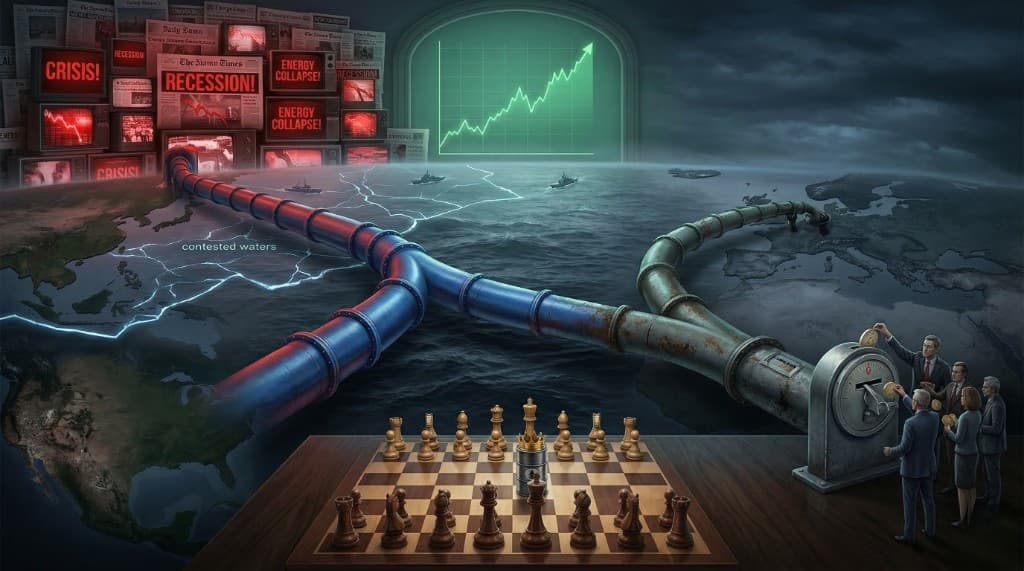
The US Doesn't Just Produce Energy — It Controls Who Gets It and at What Price
LNG is America's real geopolitical weapon — not oil. Europe is forced to buy expensive US gas after losing Russian supply. Venezuela becomes a strategic chess piece. And media outlets inflate Hormuz fears to serve US energy interests. The market knows. Do you?
Forget oil — LNG is the real weapon
The conventional analysis of geopolitical energy conflict focuses on oil. Barrels, pipelines, OPEC quotas. But the real strategic weapon in 2026 isn't crude — it's liquefied natural gas (LNG).
Here's why: oil has multiple producers, alternative sources, and a mature global trading infrastructure. If one source is disrupted, others can partially compensate. Gas is different. Gas requires specific infrastructure — liquefaction terminals, specialized tankers, regasification plants — that takes years to build and billions to finance. Once you're dependent on a gas supplier, switching is enormously expensive and slow.
The US understood this before anyone else, and has been executing a multi-year strategy:
- Break Europe's dependence on Russian gas — accomplished through sanctions, the Nord Stream situation, and diplomatic pressure
- Position US LNG as the only viable alternative — by controlling shipping routes and building export capacity
- Set the price — with Europe having no alternatives, the US effectively dictates terms
Europe didn't choose to buy American gas. It was maneuvered into a position where American gas was the only option left. That's not commerce — that's strategy.
Venezuela: not just oil, but leverage
Venezuela's role in this energy chess game goes far beyond its oil reserves — though those reserves are the largest proven in the world.
The US is increasing control over Venezuelan oil production through a combination of selective sanctions relief, investment channels, and political influence. This serves multiple strategic purposes:
- Diversifies US-aligned oil supply, reducing dependence on Middle Eastern sources that transit through Hormuz
- Weakens China's energy position — Beijing has invested heavily in Venezuelan oil infrastructure and stands to lose access if US influence grows
- Creates a Western Hemisphere energy bloc that can operate independently of Eastern routes and suppliers
Venezuela is the piece that turns US energy dominance from regional to hemispheric. Combined with Canadian oil sands and Mexican production, the Americas become a self-sufficient energy fortress — while Asia remains dependent on routes the US controls.
The Hormuz narrative machine
This is where the analysis gets uncomfortable: the threat to energy transport through the Strait of Hormuz is being deliberately exaggerated.
According to this analysis, the pattern works like this:
- Incidents occur in or near the strait — real but limited in actual impact
- Western media amplifies the threat — CNN, Financial Times, The Economist run alarming coverage about potential supply disruptions
- Insurance costs spike — maritime insurers raise premiums for vessels transiting the strait
- Transport costs increase — higher insurance means higher shipping costs, passed on to buyers (primarily Asian countries)
- US LNG becomes relatively more competitive — if shipping gas from the Gulf becomes expensive and risky, American LNG shipped via Atlantic routes looks safer and more attractive
The beneficiary of this narrative cycle is clear: US energy exporters and the strategic interests they serve.
This doesn't mean Hormuz risks aren't real — we've covered the genuine strategic dynamics extensively. But there's a difference between real risk and amplified narrative designed to move markets and insurance premiums. The media criticism isn't conspiracy theory — it's recognizing that outlets like Moody's, Financial Times, and CNN have institutional relationships with the financial system that benefits from these narratives.
When the media screams "energy crisis" but the bond market stays flat and the SP500 holds near highs, someone is lying. Hint: it's not the bond market.
Europe: paying the bill for someone else's strategy
The clearest loser in this energy realignment is Europe. The numbers are brutal:
- Gas prices in Europe remain multiples of US domestic prices — European industry pays 3-4x what American competitors pay for the same energy
- Industrial competitiveness is eroding as energy-intensive manufacturing migrates to the US or Asia
- Strategic autonomy is a fiction — Europe has no control over its energy supply routes and no independent military capacity to secure them
- No seat at the table — the energy decisions that determine Europe's economic future are made in Washington, Moscow, and Beijing
Europe's response has been to accelerate renewable energy and nuclear investment, but the timeline for reducing gas dependency is measured in decades, not years. In the meantime, Europe remains a captive customer paying premium prices for American LNG.
The irony is sharp: the sanctions that cut Russian gas were presented as protecting European security. In practice, they transferred Europe's energy dependency from Russia (cheap, close, pipeline-delivered) to the US (expensive, distant, LNG-shipped). Europe's energy bill went up. America's export revenue went up. Russia redirected supply to China. Everyone adapted except Europe.
The recession narrative vs. market reality
Financial media outlets and rating agencies have been pushing recession fears and economic risk narratives that, when tested against market data, don't hold up:
- Moody's and others warn of credit deterioration, yet junk bond spreads remain contained
- CNN and mainstream outlets frame every geopolitical event as a potential market crash, yet equities keep climbing
- The Economist and Financial Times publish alarming analyses that are consistently more bearish than what markets price in
This isn't to say risks don't exist — we've covered private credit stress and the stablecoin threat to banks in detail. Real risks are out there. But the media tendency to amplify fear beyond what data supports serves a purpose: it generates clicks, drives engagement, and — crucially — creates the volatility that financial institutions profit from.
The investment lesson: read the market, not the headline. When media fear is extreme but prices are stable, the market is telling you the risk is priced in. When media is complacent but credit spreads are widening, that's when to worry.
The energy map in 2026
The global energy architecture is being redesigned around US strategic interests:
- US → producer, controller of routes, price-setter
- Russia → benefits from higher prices, redirects to China, maintains leverage
- China → building alternatives (Russian pipelines, renewables, nuclear) but still vulnerable to maritime routes
- Europe → captive buyer, paying premium, losing competitiveness
- Gulf states → caught between US military dominance and Asian customer dependency
- Venezuela → emerging as US-aligned supply source, reducing Middle East dependency
For investors, this map suggests:
- US energy companies (LNG exporters in particular) have structural tailwinds that go beyond commodity cycles
- European industrials face headwinds that won't reverse until energy costs normalize — which could take years
- Chinese energy independence plays (nuclear, renewables, pipeline infrastructure) are long-term growth stories driven by strategic necessity
- Media-driven volatility is an opportunity, not a threat — buy the fear that the bond market doesn't validate
The next time a headline screams about energy Armageddon, check the 10-year bond yield. If it's flat, the smart money isn't worried. And neither should you be.
This analysis is based on macroeconomic commentary by José Luis Cava (HOPLA Finance). CongressFlows synthesizes publicly available market analysis to help investors contextualize congressional trading data. This is not financial advice.
Explore the data
Check the latest congressional trades and active investment signals.