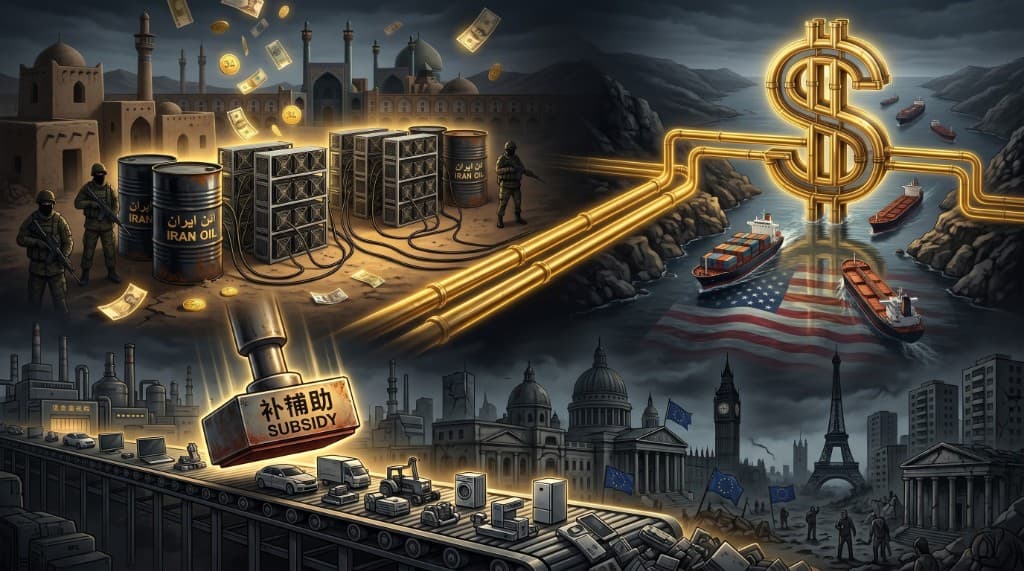
Iran's $50B Oil Revenue Goes to the Revolutionary Guard, Not Citizens. Dollar Dominance Strengthens. China's Subsidy Machine Exposed
Iran exports $50 billion in oil annually yet its citizens face 60-70% inflation. Where does the money go? The Revolutionary Guard controls oil revenues and bitcoin mining, running a parallel economy. Meanwhile, US control of Hormuz reinforces dollar dominance, markets shrug off the war, and China's massive industrial subsidies create unfair advantages that Europe refuses to address.
$50 billion in oil — and Iranians get inflation
Here's the paradox at the heart of Iran's economy: the country exports approximately $50 billion worth of oil annually. By any measure, that should provide a foundation for economic stability. Instead, Iranian citizens face:
- 60-70% inflation
- Currency in freefall (rial collapsing against the dollar)
- Crumbling infrastructure from war damage
- Shortages of basic goods
Where does the money go?
The Revolutionary Guard controls the oil revenues. They run the export infrastructure, the shipping networks, and increasingly, the country's bitcoin mining operations. Iran's economy has two layers: one for the Guard, one for everyone else.
This is not speculation. The Guard's economic empire is estimated at 30-40% of Iran's GDP. They operate ports, construction companies, telecommunications firms, and now cryptocurrency mining operations powered by Iran's cheap subsidized energy.
The result: Iran is a country rich in resources but poor in distribution. The $50 billion flows upward to the Guard's networks — funding military operations, political influence, and personal enrichment — while ordinary Iranians absorb the inflation tax.
Bitcoin: the Guard's parallel banking system
We've previously covered the Guard's cryptocurrency operations. The latest data reinforces the picture:
- The Guard runs large-scale mining farms using subsidized electricity
- Bitcoin serves as a sanctions evasion tool — convertible to hard currency without touching the traditional banking system
- Estimated $3 billion of Iran's ~$10 billion annual crypto volume flows through Guard-controlled channels
This creates a perverse dynamic: the same entity fighting the war is also profiting from it through energy-subsidized Bitcoin mining. War damages reduce civilian infrastructure, but the Guard's mining operations — often powered by dedicated generators — continue operating.
Dollar dominance: Hormuz is the enforcement mechanism
Cava's analysis of the Strait of Hormuz goes beyond energy prices. The key insight:
US control of Hormuz doesn't just affect oil. It reinforces the dollar's status as the global reserve currency.
Here's the mechanism:
- Energy is priced in dollars
- Controlling the chokepoint through which ~20% of global oil flows means controlling who trades energy and in what currency
- Countries that want energy security need dollar reserves
- Dollar demand stays structurally high → US can run deficits that no other country could sustain
The yuan can't compete. China maintains strict capital controls — you can't freely move yuan in and out of the country. A reserve currency requires free convertibility, deep liquid markets, and trust. The yuan has none of these. Despite China's economic size, the dollar's energy-backed network effect is unassailable for now.
This is why the US-China conflict is so important: it's not just about chips and rare earths. It's about maintaining the monetary architecture that funds American power.
Markets don't care about the war
The data is striking:
- SP500: At 6,885, near all-time highs
- Bitcoin: Showing relative strength against gold and equities
- Oil: Below $100, well off crisis peaks
- VIX: Elevated but not panicked
Why the resilience? Two structural factors:
1. Lower real oil prices: Adjusted for inflation, oil at $95-100 is significantly cheaper than the $150+ peaks of previous energy crises. The US economy is far less oil-intensive than in the 1970s — technology, services, and efficiency gains mean each dollar of GDP requires less energy.
2. Alternative routes are working: Iraq and Gulf countries are already circumventing the Strait of Hormuz by transporting oil via pipelines and alternative shipping routes. This directly weakens the Revolutionary Guard's leverage — their ability to threaten Hormuz closures becomes less credible as alternatives proliferate.
The combination of Fed/Treasury liquidity injections and declining geopolitical risk premium explains why the market keeps climbing despite daily headlines about conflict.
China's subsidy machine
Cava shifts to a topic that directly affects European competitiveness:
China doesn't just compete — it subsidizes its way to dominance:
- State-owned banks provide below-market loans to strategic industries
- Local governments offer free land, tax holidays, and energy discounts
- Excess capacity is dumped on global markets at prices competitors can't match
- Sectors affected: solar panels, EVs, steel, shipbuilding, telecommunications equipment
The result: Chinese companies operate with artificial cost advantages that make fair competition impossible. European manufacturers, burdened by high energy costs (partly caused by the loss of Russian gas) and strict regulations, simply cannot compete on price.
Cava's position is clear: Europe needs tariffs on Chinese industrial goods, not as protectionism, but as a correction for the market distortion created by subsidies. The US under Trump has already moved in this direction. Europe's hesitation is costing its industrial base.
Pakistan's peace role
A quieter development worth watching: Pakistan is actively mediating between the US and Iran, with implications beyond diplomacy. Pakistan faces severe electricity shortages — its grid depends partly on Iranian gas imports. A peace deal that restores energy flows would directly benefit Pakistan's economy and give it incentive to push hard for resolution.
This creates an interesting alignment: Pakistan wants peace for electricity, China wants peace for oil prices, and the US wants peace to declare victory. The only party without a clear incentive for quick resolution is the Revolutionary Guard, whose wartime economy keeps them powerful.
The investment read
This analysis reinforces several portfolio themes:
- Dollar-denominated assets remain king: US market resilience + dollar dominance = stay overweight US equities
- Bitcoin has a structural bid: Not just from institutions, but from geopolitical actors (Iran, Russia) who need censorship-resistant value transfer. Cava is preparing a dedicated bullish Bitcoin video
- European equities face structural headwinds: High energy costs + Chinese competition + regulatory burden. Avoid unless specific companies have global moats
- The war is winding down economically: Alternative oil routes, declining risk premiums, and multi-party incentives for peace all point in the same direction
This analysis is based on Cava's market commentary from April 15, 2026. For informational purposes only — not financial advice.
Explore the data
Check the latest congressional trades and active investment signals.