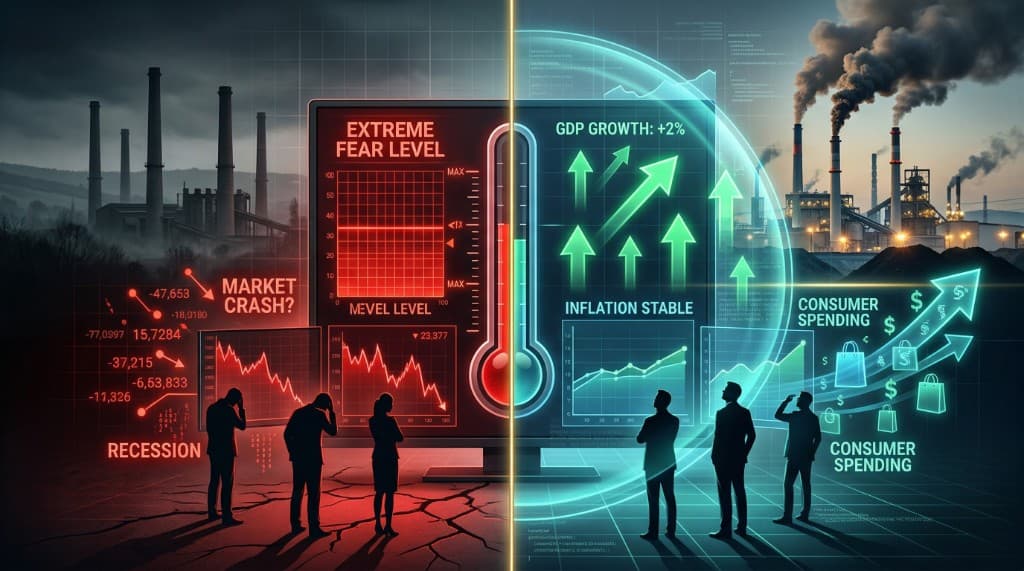
Americans Are as Scared as in 2008 — But the Economy Is Growing at 2%. Something Doesn't Add Up.
US consumer fear has hit levels not seen since the 2008 crash and the COVID lockdowns. Yet the economy is growing at 2%, inflation expectations are stable, and the top 20% keeps spending. Meanwhile, Europe's renewable energy bet is backfiring catastrophically, and China burns more coal than ever. The gap between sentiment and reality has never been wider — and that gap is where the opportunity lives.
Fear at crisis levels — without the crisis
Here's the paradox that defines the current market: US consumer fear has reached levels comparable to 2008 and 2020 — two of the most severe economic events in modern history.
In 2008, the global financial system was collapsing. Lehman Brothers had just imploded. Credit markets froze. Millions lost their homes.
In 2020, a global pandemic shut down the entire economy. Unemployment spiked to 15%. Nobody knew when — or if — things would reopen.
In 2026? The economy is growing at 2%. Inflation expectations are stable. The labor market is cooling but not crashing. Corporate profits are holding up. And yet consumers are reporting the same level of fear.
This is not rational. And that's exactly what makes it interesting.
Consumers are as scared as they were when Lehman collapsed and when COVID shut down the world. But the economy is growing, inflation is stable, and the top 20% keeps spending. The fear is real — the crisis isn't.
Who's afraid and why it matters
The composition of the fear is the most revealing detail. It's not low-income households driving the sentiment collapse — it's middle and upper income groups.
Why would the people with the most financial cushion be the most afraid? Several factors:
- Portfolio exposure — wealthier households have more invested in equities, and the market correction has hit paper wealth
- Media consumption — higher-income groups consume more financial media, which has been relentlessly negative with war coverage and recession warnings
- Geopolitical awareness — they understand the Iran conflict's implications and are pricing in worst-case scenarios that the market itself isn't confirming
- Loss aversion — the more you have, the more you fear losing it. A 15% portfolio decline hits differently when it's $150,000 versus $1,500
But here's the critical economic counterweight: the top 20% of earners drive approximately 40% of US consumer spending. And despite their fear, they're still spending.
This creates a bizarre but stable economic dynamic:
- Sentiment says recession
- Spending says growth
- The market sits between the two, waiting for one to break
Historically, spending wins. Sentiment is a lagging indicator that follows prices, not the other way around. When the peace catalyst arrives and markets rally, sentiment will flip with remarkable speed. The same consumers reporting 2008-level fear will be reporting optimism within weeks.
The 2% growth floor
The US economy growing at 2% in the current environment is actually impressive. Consider what's working against it:
- An active military conflict draining fiscal resources
- Oil prices elevated above pre-conflict levels
- Liquidity being drained from the financial system by higher energy costs
- Consumer confidence in the basement
- Global trade disruptions
And yet: 2% growth. Stable medium-term inflation expectations. The Fed holding rates steady while quietly injecting liquidity.
The resilience comes from structural factors:
- The wealth effect still works — despite portfolio drawdowns, housing values and cumulative wealth for the top quintile remain high enough to sustain consumption
- The labor market bends but doesn't break — job losses are sectoral, not systemic. The K-shaped recovery we identified in the March 19 analysis continues
- Fiscal spending on defense acts as economic stimulus — military operations require procurement, logistics, and manufacturing that feeds directly into GDP
- The Fed's stealth liquidity prevents credit markets from seizing up
This 2% floor is exactly what makes the SP500 bottom thesis so compelling. The economy isn't contracting — it's growing through adversity. When the adversity lifts, the snapback will be sharp.
Europe's renewable gamble is failing in real time
While the US navigates geopolitical turbulence from a position of energy strength, Europe is watching its energy strategy collapse.
The core problem: intermittent renewable energy cannot provide the baseload stability that an industrial economy requires.
Wind doesn't blow on demand. Solar doesn't shine at night. And when an entire continent has dismantled its nuclear capacity and cut off its gas supply, the gaps between generation and demand become existential.
The consequences are already visible:
Germany
The continent's industrial engine is sputtering. After abandoning nuclear power and losing Russian gas, Germany faces:
- Industrial production declining for the third consecutive year
- Energy-intensive manufacturers relocating to the US and Asia
- Electricity prices among the highest in the developed world
- A growing dependence on expensive American LNG with no alternative in sight
France
Even France, which wisely maintained its nuclear fleet, is strained. The European interconnected grid means French nuclear power is being used to subsidize Germany's renewable shortfalls, reducing France's own energy security margin.
The broader pattern
Europe's energy policy was built on three assumptions:
- Russian gas would remain available and cheap — wrong
- Renewables would scale fast enough to replace baseload — wrong
- Geopolitical crises wouldn't expose the vulnerability — catastrophically wrong
Europe bet its entire industrial future on wind turbines and solar panels replacing nuclear and gas. The wind isn't blowing hard enough, the sun isn't shining long enough, and the gas bills are arriving. This isn't a transition — it's a slow-motion industrial suicide.
For investors, the implications are clear and consistent with what we've been saying: European equities face structural headwinds that no ceasefire will fix. The energy cost disadvantage is baked in for years, possibly decades.
China's coal reality
One of the most underreported stories in the global energy narrative: China burns more coal than the rest of the world combined — and it's increasing, not decreasing.
Despite massive investments in solar panel manufacturing and EV production (both largely for export), China's domestic energy mix remains overwhelmingly fossil fuel. The country is:
- Building new coal plants at a pace that dwarfs global renewable additions
- Using coal for approximately 60% of electricity generation
- Increasing coal imports to meet growing industrial demand
This matters for two reasons:
1. The "green China" narrative is marketing, not reality. China manufactures solar panels; it doesn't depend on them for its own energy. It sells the dream to Europe while burning coal at home.
2. China has cheap, reliable energy — Europe doesn't. This is a competitive advantage that compounds over time. Every European factory that closes due to energy costs has a Chinese competitor ready to absorb its market share.
The geopolitical irony: Europe buys Chinese solar panels (manufactured with coal power) to replace the nuclear and gas plants that gave it cheap energy. The result is higher European energy costs, increased Chinese market share, and a transfer of industrial capacity from West to East.
The sentiment-reality gap: where opportunity lives
The current environment presents a textbook contrarian setup:
| Indicator | Signal | |-----------|--------| | Consumer sentiment | Crisis-level fear (bearish) | | Actual GDP growth | 2% positive (bullish) | | Inflation expectations | Stable (neutral-bullish) | | Fed policy | Stealth liquidity injection (bullish) | | Oil trajectory | Below $100, declining (bullish) | | Peace timeline | 4 months (bullish) | | SpaceX IPO | Needs bull market (bullish) | | Market breadth | All sectors capitulated (bottoming signal) |
When sentiment is at crisis levels but fundamentals don't confirm a crisis, sentiment eventually catches up to reality — not the other way around. Every major market bottom in modern history (2009, 2020, 2022) featured this exact gap between what people felt and what the data showed.
What to watch
- University of Michigan Consumer Sentiment — further decline toward 50 would mark extreme capitulation; a bounce signals the turn
- Retail spending data — as long as the top 20% keeps spending, the 2% growth floor holds
- European industrial production — monthly data from Germany, France, and Italy tracking the deindustrialization pace
- China coal import data — increasing imports confirm the structural energy advantage over Europe
- Congressional trading patterns — check the CongressFlows dashboard for whether representatives are buying into the fear or positioning for recovery
- VIX vs. consumer sentiment divergence — if VIX drops while consumer sentiment stays low, institutions are buying what retail is afraid of
This analysis is based on macroeconomic commentary by José Luis Cava (HOPLA Finance). CongressFlows synthesizes publicly available market analysis to help investors contextualize congressional trading data. This is not financial advice.
Explore the data
Check the latest congressional trades and active investment signals.