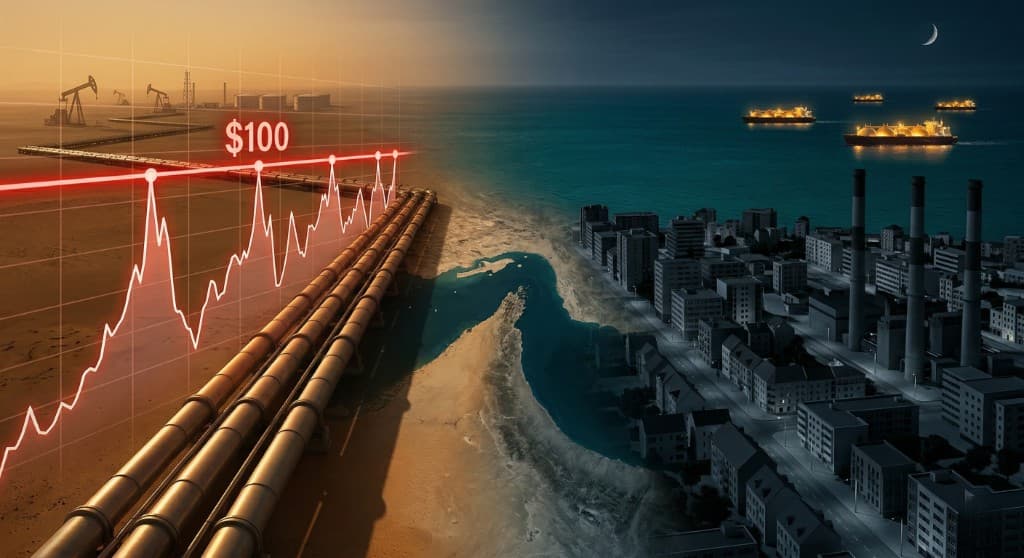
25 Days of War, Oil Still Below $100 — The Market Is Telling You This Conflict Is Over
After 25 days of active conflict with Iran, oil refuses to break above $100. Physical exports continue. Peace talks converge on Islamabad. And Europe emerges as the biggest loser — paying the highest energy prices on the continent that once had the cheapest. The market saw the ending before the diplomats announced it.
The $100 ceiling that won't break
Twenty-five days of active military conflict between the US-Israel coalition and Iran. Twenty-five days of headlines screaming about supply disruptions, Hormuz closures, and energy catastrophe.
And oil is still below $100.
This single data point demolishes every catastrophic forecast made since the conflict began. Not the analysts' $120-$130 predictions. Not Blanchard's $150-$200 scenario. Not even the $100 psychological barrier has held.
Why? Because the physical market doesn't lie:
- Iran is still exporting oil. Despite military action, Iranian crude continues flowing — through alternative routes, pre-existing contracts, and intermediaries willing to handle sanctioned cargo
- Russia is still pumping. Moscow's production hasn't changed; if anything, the chaos has given Russia cover to maintain maximum output with less scrutiny
- Market manipulation is real but has limits. Trump can influence the narrative, he can pressure OPEC, he can time announcements — but he cannot override the physical reality of barrels moving through pipelines
After 25 days of war, oil can't hold above $100. Either this is the weakest energy crisis in modern history — or the market has already priced in the peace that hasn't been announced yet.
The futures market told us this was coming weeks ago. The downward-sloping curve priced in conflict resolution within 2-4 weeks. We're now at day 25, right on schedule.
Islamabad: where the war ends
The convergence of diplomatic signals toward Islamabad is now unmistakable:
- Pakistan as mediator — exactly as we identified after Trump's tweet, Pakistan is the trusted intermediary for both sides
- China as architect — Beijing's fingerprints are on every aspect of this mediation. Pakistan doesn't make diplomatic moves of this magnitude without Chinese approval
- A summit appears imminent — the language from all parties has shifted from "no negotiations" to "we're not aware of formal talks," which in diplomatic parlance means "talks are advanced enough that we're preparing the announcement"
The pattern is textbook: deny negotiations → extend deadlines → announce surprise summit → claim credit for peace. We're between stages 2 and 3 right now.
When the Islamabad summit is formally announced, expect:
- An immediate 5-8% oil price drop as the war premium evaporates
- A sharp equity rally — the bottom signal we identified gets its catalyst
- Gold to initially dip further before Chinese demand reasserts control
- A wave of "we predicted this" takes from the same analysts who were screaming $150 oil two weeks ago
Trump and the Hormuz playbook
What Cava highlights is essential to understanding the current oil dynamics: Trump isn't reacting to the oil market — he's conducting it.
The Strait of Hormuz isn't just a chokepoint; it's a lever. Control the narrative around Hormuz and you control:
- Insurance premiums on tanker routes — which directly affect delivered prices
- Speculative positioning — traders react to perceived risk, not actual disruption
- Negotiating leverage — "I can close this strait permanently" is the unspoken threat behind every demand
This is consistent with the broader US energy dominance strategy we've been tracking: the US doesn't need to physically blockade Hormuz. It just needs the world to believe it could — and to price that risk into every barrel.
The genius (or cynicism, depending on your perspective) is that this manipulation keeps oil prices elevated enough to benefit US producers, but below the $100 threshold that would trigger genuine economic damage domestically. It's a controlled burn, not a wildfire.
Europe: the collateral damage that was always the point
This is the part of Cava's analysis that should alarm every European investor. The energy crisis isn't a side effect of the conflict — Europe's energy vulnerability is a feature, not a bug.
The chain of events:
- Germany exits nuclear power — eliminating the continent's most reliable baseload energy source
- Russia's gas gets cut — whether by sanctions, sabotage (Nord Stream), or political pressure
- Europe becomes dependent on US LNG — the most expensive gas on the market, as we detailed in our analysis
- Every geopolitical crisis amplifies the pain — because Europe has no energy sovereignty, no strategic reserves comparable to the US SPR, and no alternative suppliers at scale
The result: European industrial competitiveness collapses. Energy-intensive manufacturing — chemicals, metals, glass, ceramics — migrates to the US or Asia where energy is cheaper. Europe deindustrializes not by accident, but by design.
Europe went from having cheap Russian gas and nuclear baseload to paying premium prices for American LNG and praying the wind blows. This isn't bad luck. This is what happens when energy policy is made by ideologues instead of engineers.
The numbers tell the story:
- European gas prices are 3-5x higher than US domestic prices
- German industrial production has been declining since 2018
- European competitiveness rankings have dropped across every major index
The control thesis
Cava makes a provocative but not unreasonable argument: Europe's ruling class is implementing a control model that resembles China's social management system — digital currency for transaction surveillance, energy dependency for compliance, and media narrative management for consent.
Whether you accept this as deliberate strategy or emergent dysfunction, the observable facts are:
- The digital euro is advancing despite minimal public demand
- Energy rationing frameworks were tested during the 2022 crisis
- Media consolidation in Europe has accelerated
For investors, the political philosophy matters less than the investment implications: European equities face structural headwinds that won't resolve with a ceasefire in the Middle East. The energy cost disadvantage is permanent until policy changes that no current government is proposing.
What the oil market is really saying
Strip away the geopolitics, the manipulation, and the media noise. The oil market is communicating three things clearly:
1. The conflict is ending. Prices below $100 after 25 days of war mean the market has already moved past the crisis. Physical flows confirm this.
2. Inflation won't spike. As we've argued since the conflict began, the bond market has been right all along — the 10-year yield's stability signals transitory supply disruption, not structural inflation.
3. The post-conflict world favors the US. Higher energy prices benefit American producers. Weakened European competitiveness benefits American industry. Chinese diplomatic gains are real but secondary to economic positioning.
What to watch
- Islamabad summit announcement — the date will mark the official market turning point
- Oil below $90 — would signal full normalization and confirm the crisis premium has evaporated completely
- European industrial data — watch German manufacturing PMI and energy-intensive sector output for structural decline confirmation
- Congressional trades around energy stocks — check the CongressFlows dashboard for positions taken by representatives who sit on energy and foreign affairs committees
- Digital euro timeline — ECB announcements on implementation schedules signal the pace of the European control framework
- SP500 breakout above the 200-day moving average — the technical confirmation that the bottom is in and the rally has legs
This analysis is based on macroeconomic commentary by José Luis Cava (HOPLA Finance). CongressFlows synthesizes publicly available market analysis to help investors contextualize congressional trading data. This is not financial advice.
Explore the data
Check the latest congressional trades and active investment signals.