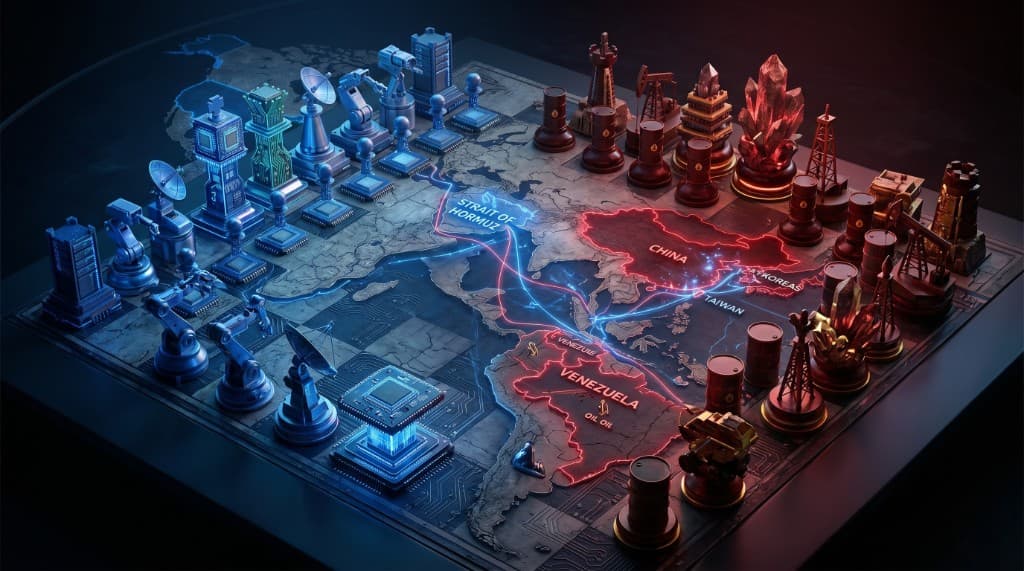
The Real War Is US vs China for AI Supremacy: Rare Earths, Oil Routes, and the Strait of Hormuz as Weapons
Forget the Iran narrative. The real conflict is between the US and China over who controls the resources that power artificial intelligence. Rare earths, advanced chips, oil supply routes, Venezuela, the Strait of Hormuz — they're all pieces in the same chess game. Trump's tariffs, Netanyahu's military coordination, and China's retaliatory export controls are moves in a resource war that will define the next decade. The SP500 stays stable because markets know: this is controlled escalation, not chaos.
This was never about Iran
We've been covering the Iran conflict for weeks. The peace talks, the economic damage, the Strait of Hormuz deployments. But Cava has now laid out the bigger picture — and it reframes everything.
The war in the Middle East is not about Iran. It's about who controls the raw materials and energy routes that power artificial intelligence.
The two contestants: the United States and China. Everything else — tariffs, sanctions, military strikes, media narratives — is a move on this chessboard.
The AI resource chain
To understand the conflict, follow the supply chain backward from an AI model to the ground:
- AI models need massive computing power
- Computing power requires advanced chips (GPUs, TPUs, custom silicon)
- Advanced chips need rare earth materials for manufacturing
- Chip fabrication requires specialized machines (ASML's EUV lithography)
- Data centers running these chips consume enormous amounts of energy
Whoever controls steps 3, 4, and 5 controls the future of AI. And right now:
- China controls ~70% of global rare earth processing
- The US controls advanced chip design (NVIDIA, AMD, Apple) and allies control fabrication (TSMC, ASML)
- Energy routes — oil and gas — run through chokepoints that can be weaponized
Move and countermove
The sequence Cava lays out is strategic chess:
US offensive:
- Trump imposes tariffs on Chinese goods — economic pressure
- Export controls block China from buying advanced chips and ASML machines — technology denial
- Seize strategic influence over Venezuelan oil — energy leverage
- Military coordination with Netanyahu against Iran — control of the Strait of Hormuz, China's primary energy lifeline
China's response:
- Retaliatory export controls on rare earth materials — hitting US chip manufacturing
- Planned Siberian gas pipeline — reducing dependence on Middle Eastern energy routes
- Military supplies to all parties in the Middle East conflict — influence without direct combat
- Pressure on Iran to accept ceasefire — protecting its own energy supply
Venezuela: the forgotten piece
Most analysis treats Venezuela as a separate story. It's not. The US capture of Venezuelan oil influence serves a dual purpose:
- Direct benefit: More oil for US refining and export
- Strategic denial: China's Sandón refinery complex depends on Venezuelan and Iranian crude. Cut both supplies and China's refining capacity is compromised
Every energy move the US makes can be traced back to one objective: ensure China cannot independently fuel its AI ambitions.
The Syria pipeline
One of the most revealing details: the proposal to reactivate an oil pipeline through Syria that would bypass the Strait of Hormuz entirely. This would:
- Give the US and allies an alternative route immune to Iranian disruption
- Reduce the strategic value of the Strait of Hormuz over time
- Further isolate Iran's leverage in future negotiations
This is long-term infrastructure thinking — not the behavior of nations expecting a quick resolution.
Why the SP500 stays calm
Here's what confuses people: if there's a resource war between the world's two largest economies, why isn't the stock market crashing?
Because this is controlled escalation. Both sides know the limits:
- The US needs Chinese rare earths (for now)
- China needs Western chip technology (for now)
- Neither side benefits from total economic war
- The Fed and Treasury keep injecting liquidity to absorb shocks
Markets aren't stupid. They see tariffs and export controls as negotiating tools, not economic suicide. The SP500 at 6,885 reflects this: geopolitical noise is high, but the structural economic machine keeps running.
Media narratives aim to induce fear. Markets aim to price reality. When the two diverge, follow the money.
The investment implications
This framework changes how we should think about several sectors:
Winners in the AI resource war:
- Semiconductor equipment (ASML results Wednesday — critical reading)
- US chip designers (NVIDIA, AMD) — even with short-term headwinds, they're strategic national assets
- Rare earth miners outside China (MP Materials, Lynas) — if China restricts exports, alternatives become priceless
- Defense and infrastructure — both sides are investing heavily
- Energy producers — controlling supply routes means controlling prices
Losers:
- Companies dependent on Chinese rare earth imports without alternatives
- European industry caught between both powers without strategic autonomy
- Media credibility — as Cava notes, the gap between narrative and reality keeps widening
The humanitarian cost
Cava ends with something we shouldn't forget amid the geopolitical analysis: 150 girls were murdered in the crossfire of these strategic calculations. Behind every chess move, every tariff, every military deployment, there are real people paying the price.
The markets may be stable. The strategies may be rational. But the cost is measured in lives, not basis points.
This analysis is based on Cava's market commentary from April 14, 2026. For informational purposes only — not financial advice.
Explore the data
Check the latest congressional trades and active investment signals.