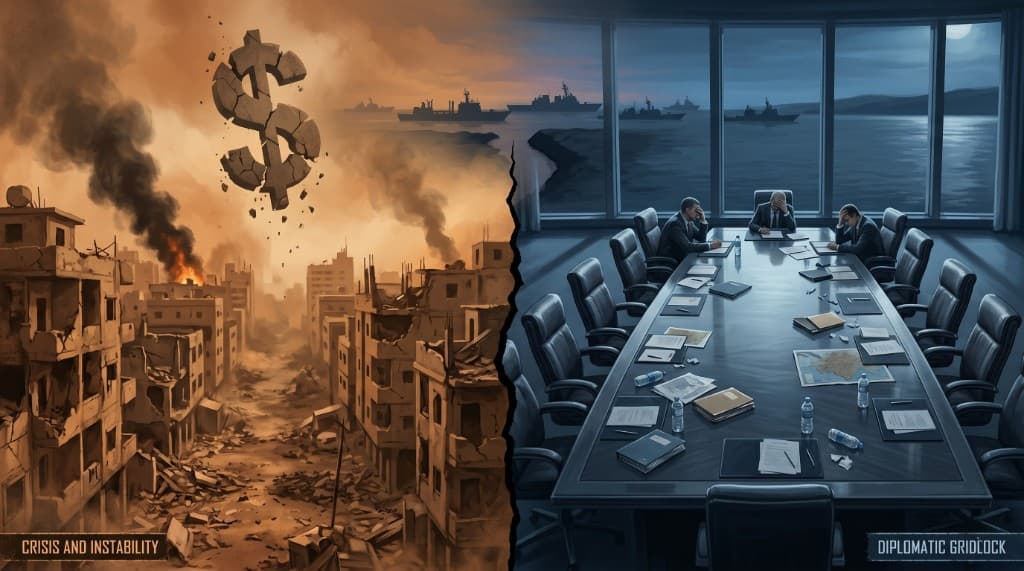
Iran Sends 70 Delegates to Peace Talks — A Sign of Weakness, Not Strength. Economy in Freefall, Hormuz Moves Symbolic
Iran's massive 70-person delegation to peace talks reveals deep internal fractures, not negotiating power. With inflation at 60-70%, GDP down 20%, and infrastructure destroyed, the regime is negotiating from desperation. Meanwhile, US naval deployments in the Strait of Hormuz are political theater for elections, not economic strategy. Markets sense the worst is over: oil below $100, gold rising, and cautious optimism building.
70 delegates don't mean strength — they mean chaos
When a country sends 70 people to a peace negotiation, the instinctive reaction is: "They must be taking this seriously." The reality is the opposite.
A delegation that large doesn't reflect unity. It reflects internal fractures so deep that every faction demands a seat at the table to protect its own interests.
The Iranian delegation includes military officials, Revolutionary Guard representatives, economic advisors, and political factions — each with competing agendas. The Guard wants to preserve its economic empire (estimated at 30-40% of Iran's economy). The military wants reconstruction funding. The moderates want sanctions relief. The hardliners want to save face.
This is not a negotiation — it's a factional power struggle being played out in front of the Americans.
The Iranian economy is in freefall
Let's quantify the damage:
- Inflation: Estimated at 60-70%, devastating purchasing power for ordinary Iranians
- GDP loss: An estimated 20% decline from direct war damages alone
- Infrastructure: Extensive destruction of energy infrastructure, transport networks, and industrial capacity
- Currency: The rial continues its collapse, with black market rates diverging further from official rates
- Oil revenue: Despite higher global prices, Iran's ability to export has been severely constrained
This is not a country negotiating from strength. This is a country that needs a deal to survive, but whose internal power dynamics make that deal extraordinarily difficult to reach.
Iran's economy was already fragile before the conflict. Sanctions, mismanagement, and the Revolutionary Guard's economic dominance had created structural weaknesses. The war turned cracks into chasms.
The Strait of Hormuz: political theater
The US has deployed additional naval assets to the Strait of Hormuz. The media frames this as strategic pressure. Cava's reading is different — and more cynical:
These deployments are primarily for domestic political consumption. With elections approaching, showing naval force in the world's most important energy chokepoint plays well on television. The actual economic impact on Iran is marginal compared to the internal destruction already suffered.
The real pressure on Iran comes from:
- Infrastructure damage that will take years to repair
- Inflation destroying the social contract between the regime and its people
- The Revolutionary Guard's declining ability to fund its networks
- China's pressure to accept a ceasefire (as we've covered previously)
What markets are telling us
The market reaction to the peace talks is instructive:
- Oil below $100: After briefly touching $103 during peak tensions, prices have settled. The futures curve maintains its negative slope — markets expect resolution
- Gold rising: Safe-haven demand persists, but the rise is orderly, not panicked. Central banks continue accumulating
- Equities recovering: The SP500's move to 6,900 driven by liquidity injections suggests the worst of the geopolitical risk premium has been priced in
- Initial decline then recovery: The classic pattern — sell the rumor, buy the news
Markets are forward-looking. Oil below $100 and a recovering SP500 tell you that smart money believes this conflict is winding down — even if the peace process takes months.
The 20-month timeline
Don't expect a quick resolution. Historical precedent (including previous Iran negotiations) suggests these talks could extend approximately 20 months. During that period:
- Short-term: Volatility on headline risk (every tweet, every statement will move markets briefly)
- Medium-term: Gradual normalization of energy flows, declining risk premiums
- Long-term: Massive reconstruction spending in Iran (infrastructure, energy, transport) — a potential investment theme
The Revolutionary Guard remains the wildcard. Their economic interests are directly threatened by any deal that opens Iran to international capital, and their influence over the delegation could derail progress at any point.
The investment read
For positioning purposes:
- Energy: Oil below $100 with peace talks ongoing supports the thesis that the worst spike is behind us. Energy stocks may have peaked on the geopolitical premium
- Gold: Continues to benefit from structural forces (central bank buying, debt concerns) even as geopolitical risk moderates
- Equities: The combination of Fed/Treasury liquidity and declining geopolitical risk supports the bull case. Congressional buying patterns we've been tracking confirm institutional optimism
- Defense: Reconstruction will take years. Defense and infrastructure companies remain well-positioned regardless of peace timeline
The peace process will be messy, slow, and full of contradictions. But the direction of travel is clear. Iran cannot sustain the current situation. The only question is how long internal politics delays the inevitable.
This analysis is based on Cava's market commentary from April 13, 2026. For informational purposes only — not financial advice.
Explore the data
Check the latest congressional trades and active investment signals.