This War Was Never About Iran — It's US vs. China. And the Economy Just Proved Everyone Wrong.
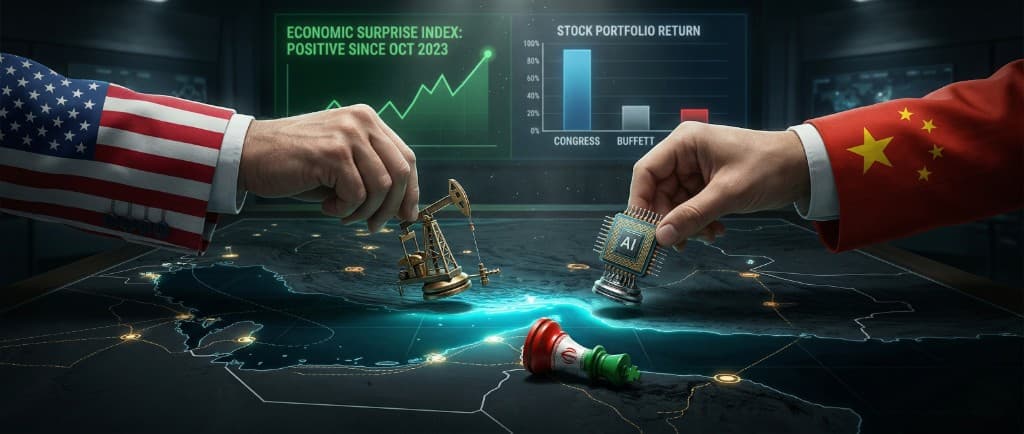
Western media says the US lost to Iran. The data says the opposite: Hormuz closure benefits America, Iran's economy crumbles, and China — the real adversary — is pressuring Tehran to accept a ceasefire. The US economic surprise index has been positive since October 2023. Stock indices barely declined. And congress members like Ron Kampa keep outperforming Buffett. The narrative and the reality have never been further apart.
The war you're watching isn't the war being fought
The Western media narrative is clear: the US and Israel are bogged down in Iran. The mighty American military failed. Iran won.
The data tells a completely different story:
- Iran's economy is struggling — despite higher oil revenues, the broader economy is under severe strain from infrastructure damage, sanctions, and disrupted trade
- The Strait of Hormuz closure benefits the US — American energy producers don't need Hormuz. European and Asian buyers do. Every day the strait is restricted, US LNG and crude exports become more valuable
- Iran is being pressured to accept a ceasefire — not by the US military, but by China
That last point is the key that unlocks the entire conflict: this was never a war between the US and Iran. It's a war between the US and China, with Iran as the battlefield.
Media says the US lost to Iran. Reality: Hormuz closure helps US energy exports, Iran's economy crumbles, and China — the actual adversary — is pressuring Tehran to accept terms. The war you see on TV isn't the war being fought.
The US-China dimension: AI, energy, and leverage
The deeper strategic layer of this conflict revolves around two things: artificial intelligence and energy pricing.
AI as strategic resource
The race for AI supremacy requires massive energy inputs — data centers, chip fabrication, cooling systems. The country that controls energy supply and pricing controls the pace of AI development. By dominating energy flows through Hormuz control and LNG exports, the US can influence the energy costs that China's AI ambitions depend on.
China's uncomfortable position
China's involvement reveals its dilemma:
- Supplies military components to Iran through rare earth materials — maintaining influence and intelligence
- Suffers from higher oil prices — China imports the majority of its energy, and elevated prices hit its manufacturing base and already-fragile economy
- Disrupted gas supplies through Hormuz affect Chinese energy security directly — explaining why Iran stopped methane tankers to Pakistan and China
- Pressures Iran to accept ceasefire — because the war's costs to China now exceed its benefits
This is the pattern we identified when we first discussed China mediating through Pakistan: Beijing's diplomatic moves aren't altruistic — they're self-interested. China needs this war over because China is losing from it.
The peace timeline we've been tracking was always driven by Chinese pressure on Iran, not American military pressure. Bombs didn't end this — economics did.
The economy that refused to collapse
Here's the data point that should end every recession debate: the US economic surprise index has been consistently positive since October 2023.
That means, for over two and a half years, the US economy has been delivering results above expectations. Not just growing — growing better than economists predicted, month after month.
During that period we've had:
- The Iran conflict
- Oil price spikes
- Consumer fear at 2008 levels
- Media predicting recession non-stop
- Analysts calling for SP500 at 5,400
And the economy kept beating expectations. Every single time.
This is the ultimate vindication of our thesis: the narrative and the reality operate on different tracks. The media sells fear because fear generates clicks. The economy generates growth because the structural drivers — Fed liquidity, consumer spending from the top 20%, defense stimulus, energy exports — are all intact.
The economic surprise index has been positive since October 2023. For 30 straight months, the US economy has beaten expectations. Every recession call was wrong. Every crash prediction failed. The economy doesn't watch the news.
Stock market: the correction that wasn't
Look at the actual damage to major indices through this entire conflict:
The decline has been marginal. Not a bear market. Not a crash. Not even a standard correction by historical standards. Indices pulled back slightly and have been moving sideways — consolidating, not collapsing.
This confirms everything we've been tracking:
- The false breakout at 6,361 was the low
- The 11-sector capitulation was the washout
- Insiders bought while analysts sold
- The bottom signal table had 8 of 8 indicators confirmed
A new upward wave is expected. The ceasefire — which China is pushing Iran toward — will be the catalyst that converts the sideways consolidation into a directional move higher.
With the Fed unable to stop printing, new leadership at the Federal Reserve, and the SpaceX IPO needing a bull market, the forces aligned for a rally haven't diminished — they've strengthened.
Congress beats Buffett: the names
We covered this theme last post, but now we have specific names. Ron Kampa and Donald Trump are among those whose stock returns outperform Warren Buffett.
Think about what that means:
- A sitting congressman with access to committee briefings, legislative drafts, and classified intelligence consistently achieves returns that the greatest professional investor in history cannot match
- A president with access to every piece of intelligence, every upcoming policy decision, and every market-moving announcement generates superior returns
This isn't skill. This isn't luck. This is structural informational advantage being converted into financial gain.
The STOCK Act was supposed to prevent this. Instead, it merely created a disclosure requirement with a 45-day delay — long enough for every trade to be profitable before the public sees it.
At CongressFlows, we track every disclosed trade. But the real power of the data isn't in copying individual trades — it's in:
- Pattern recognition — who consistently outperforms, and what committees do they sit on?
- Timing analysis — do their trades cluster before major announcements?
- Day-of-week patterns — the feature we're building to detect Friday sellers who consistently trade before weekend news
- Sector signals — when multiple congress members buy the same sector simultaneously
The rankings feature we're developing will make this analysis accessible to every retail investor. If congress members are going to trade on insider information, the least we can do is make their trades visible and analyzable.
The ceasefire catalyst
All signals point to a ceasefire in the near term:
- China is actively pressuring Iran — the economic cost to Beijing has exceeded tolerance
- The Strait of Hormuz reopening will normalize oil prices and reduce global uncertainty
- The US has achieved its strategic objectives — energy dominance, weakened Iranian influence, defense stimulus, agricultural trade growth
- All parties want out — the convergence of interests we identified weeks ago is reaching its conclusion
When the ceasefire is announced:
- SP500 rallies as war premium evaporates and shorts cover
- Oil drops to $75-85 range
- Gold initially dips then recovers on Chinese demand
- Bitcoin breaks above key resistance on risk-on sentiment
- European equities get a temporary bounce but structural problems persist
What to watch
- Ceasefire announcement timing — Chinese diplomatic language is the leading indicator; any formal acknowledgment from Beijing triggers the rally
- Strait of Hormuz reopening schedule — phased reopening vs. full reopening determines the speed of oil price normalization
- Economic surprise index — continued positive readings confirm the recovery narrative
- New Fed leadership signals — any language about balance sheet policy sets the tone for the next cycle
- Congressional trades from March-April — the disclosure window is opening. Check CongressFlows for trades by intelligence and armed services committee members around key conflict dates
- Ron Kampa and other top-performing congress members — track their next disclosed trades as potential signals
This analysis is based on macroeconomic commentary by José Luis Cava (HOPLA Finance). CongressFlows synthesizes publicly available market analysis to help investors contextualize congressional trading data. This is not financial advice.
Explore the data
Check the latest congressional trades and active investment signals.