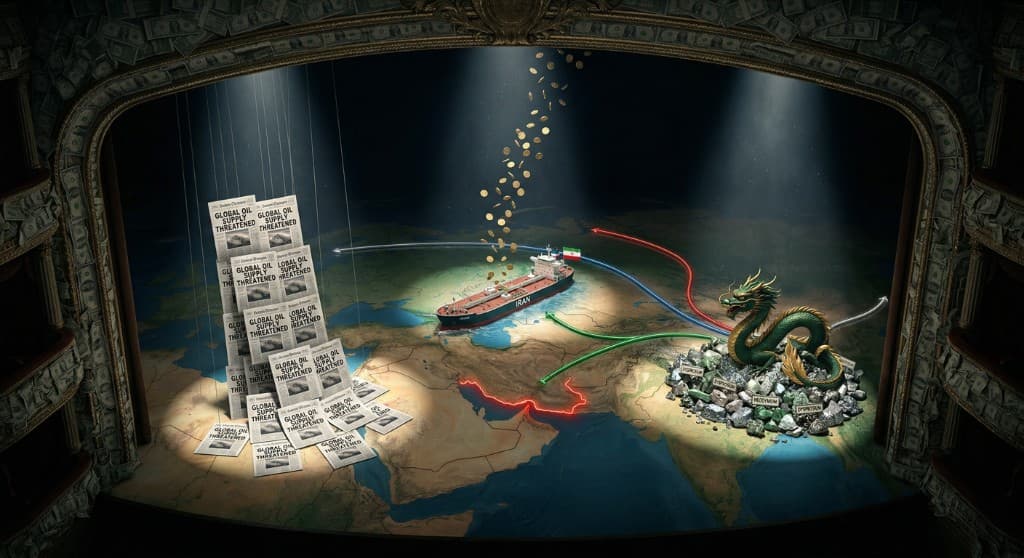
The Media Leak Was Coordinated, Iran's Oil Revenue Is Up, and China Sells Weapons to Everyone — Follow the Money
Every major Western outlet leaked the same classified speech at the same time — that's not journalism, that's an operation. Meanwhile, Iran is making MORE money from oil than before the war. The US defense budget is booming. And China quietly sells rare earths and military components to every side without firing a shot. The market sees through it all: indices move sideways, oil flatlines. This is noise, not crisis.
The leak that wasn't a leak
Every major Western media outlet published the same confidential information about Trump's speech at the same time. Word for word. Identical framing. Simultaneous release.
That's not investigative journalism. That's a coordinated information operation.
When a genuine leak happens, one outlet breaks the story and others scramble to confirm. When every outlet publishes simultaneously, the information was distributed, not discovered. Someone in the chain of power decided that this specific narrative needed to reach the public at this specific moment.
And here's the twist: the speech contained nothing new. No policy changes. No escalation. No withdrawal. It was recycled content repackaged as breaking news.
Why coordinate a leak of non-news? Because the goal isn't to inform — it's to maintain a narrative. Keep the public's attention focused on the conflict. Keep the fear alive. Keep the perception of crisis elevated even as the actual market data tells a completely different story.
When every media outlet leaks the same classified information at the same time, it's not a leak — it's a broadcast. And when the content contains nothing new, the message isn't the speech. The message is: "stay afraid."
This is exactly the media narrative manipulation pattern we've been tracking. The gap between what the media says and what the market does has never been wider.
Iran: the war that pays for itself
Here's the detail that should reframe everything you think about this conflict: Iran's oil revenues have increased since the war began.
Read that again. A country under military attack, subject to sanctions, with its infrastructure being targeted — is making more money from oil than it was during peacetime.
How?
- Higher oil prices — the conflict itself pushed crude above $95, and Iran's production costs haven't changed. Every additional dollar per barrel goes straight to revenue
- The Strait of Hormuz remains open — despite all the military posturing, the US is allowing Iranian oil to pass through. This is the clearest signal of behind-the-scenes negotiations. You don't let your enemy's revenue stream flow if you're trying to defeat them economically
- Alternative buyers don't care about sanctions — China, India, and other Asian nations continue purchasing Iranian crude through intermediaries, shadow fleets, and creative banking arrangements
- Discounted but volume-compensated — Iran sells at a discount to market price, but higher absolute prices mean the discount still results in more total revenue than pre-war pricing
This fact demolishes the narrative that the conflict is about defeating Iran. If the US wanted to cripple Iran economically, it would blockade Hormuz. It hasn't. If the US wanted to stop Iranian oil exports, it could enforce sanctions more aggressively. It hasn't.
The conflict serves other purposes — energy market control, European dependency, defense industry stimulus, and negotiating leverage. But destroying Iran's economy isn't one of them.
The US defense economy: war as stimulus
While media narratives focus on the costs of conflict, the economic reality is more nuanced — and more cynical. The US economy is benefiting from the war through several channels:
Oil exports
The US is the world's largest oil producer. Higher prices mean higher revenue for domestic producers, more energy sector employment, and improved trade balance. The conflict is net positive for the American energy sector.
Defense spending surge
Military operations require massive procurement:
- Missile inventory replenishment — every Tomahawk, JDAM, and precision munition fired needs to be replaced. That's billions in orders flowing to Raytheon, Lockheed Martin, Northrop Grumman, and their supply chains
- Naval deployment costs — maintaining carrier groups near Hormuz requires fuel, logistics, provisions, and maintenance — all domestic economic activity
- Intelligence and surveillance — increased spending on satellite, cyber, and signals intelligence benefits the tech-defense sector
The multiplier effect
Defense spending has one of the highest fiscal multipliers in economics. Every dollar spent on procurement cascades through supply chains, employing workers who spend their wages, generating tax revenue, and stimulating related industries.
This is the uncomfortable truth: war is economically stimulative for the country waging it, at least in the short term. The 2% GDP growth we're seeing isn't happening despite the conflict — part of it is happening because of it.
For congressional trade watchers, the implication is direct: representatives on the Armed Services and Defense Appropriations committees have material non-public information about procurement contracts, deployment timelines, and budget allocations. Check the CongressFlows dashboard for any unusual activity in defense sector stocks.
China: the arms dealer that fights no one
China's role in this conflict is the most strategically brilliant play on the board — and the least discussed.
China supplies critical materials and components to every party in the conflict:
- Rare earth materials — essential for precision munitions, radar systems, electronic warfare, and communications equipment. China controls approximately 60-70% of global rare earth production and an even larger share of processing
- Military components — electronics, sensors, and materials that end up in weapons systems on multiple sides of the conflict
- Technology — dual-use technologies that can be applied to both civilian and military applications
The genius of China's position:
- No military engagement — zero Chinese soldiers in the conflict zone. Zero risk of casualties. Zero domestic political cost
- Revenue from all sides — selling materials and components to everyone means revenue regardless of who wins
- Strategic intelligence — supplying weapons systems gives China insight into the capabilities and consumption rates of all parties
- Leverage accumulation — every nation dependent on Chinese rare earths and components becomes a future negotiating chip
- Diplomatic positioning — mediating peace through Pakistan while profiting from the war gives China influence in both the conflict and its resolution
China doesn't need to fire a single bullet. It sells rare earths to the US, components to Iran, technology to Russia, and solar panels to Europe. It mediates the peace. It profits from the war. And when it's over, every party owes Beijing something. This isn't strategy — it's art.
This is the pattern of a rising superpower: accumulate economic leverage, avoid military exposure, and position yourself as indispensable to all sides.
The market's verdict: noise
With all this geopolitical complexity, what are markets actually doing?
Moving sideways.
- Stock indices: lateral movement around recent levels
- Oil prices: range-bound, refusing to break above $100
- Bond yields: stable, confirming no inflation panic
- VIX: elevated but not spiking on new headlines
This is the market telling you, in the clearest possible terms: the current news cycle is noise, not signal.
Markets have already priced in the conflict. They've priced in the peace timeline. They've absorbed the fear and the manipulation. What's left is a market waiting for its catalyst — and that catalyst is the formal acknowledgment of negotiations that everyone already knows are happening.
The lateral movement is actually bullish. It means:
- Sellers are exhausted — if bad news can't push prices lower, the downside is limited
- Buyers are accumulating — institutional money is building positions quietly during the range
- The spring is coiling — the longer the consolidation, the more powerful the breakout
What to watch
- Media coordination patterns — identical leaks across outlets signal manufactured narratives. Track what the market does after the headlines (nothing = noise confirmed)
- Iranian oil export data — continued revenue growth despite conflict confirms the war isn't about economic pressure on Iran
- US defense procurement announcements — new contracts and budget supplementals signal the economic stimulus channel
- Rare earth prices and Chinese export quotas — any restriction signals China leveraging its strategic position
- Congressional trades in defense stocks — check CongressFlows for Armed Services and Appropriations committee members positioning in RTX, LMT, NOC, GD
- SP500 range breakout — the longer the sideways consolidation, the more powerful the eventual directional move. Watch 6,470 resistance for the breakout trigger
This analysis is based on macroeconomic commentary by José Luis Cava (HOPLA Finance). CongressFlows synthesizes publicly available market analysis to help investors contextualize congressional trading data. This is not financial advice.
Explore the data
Check the latest congressional trades and active investment signals.