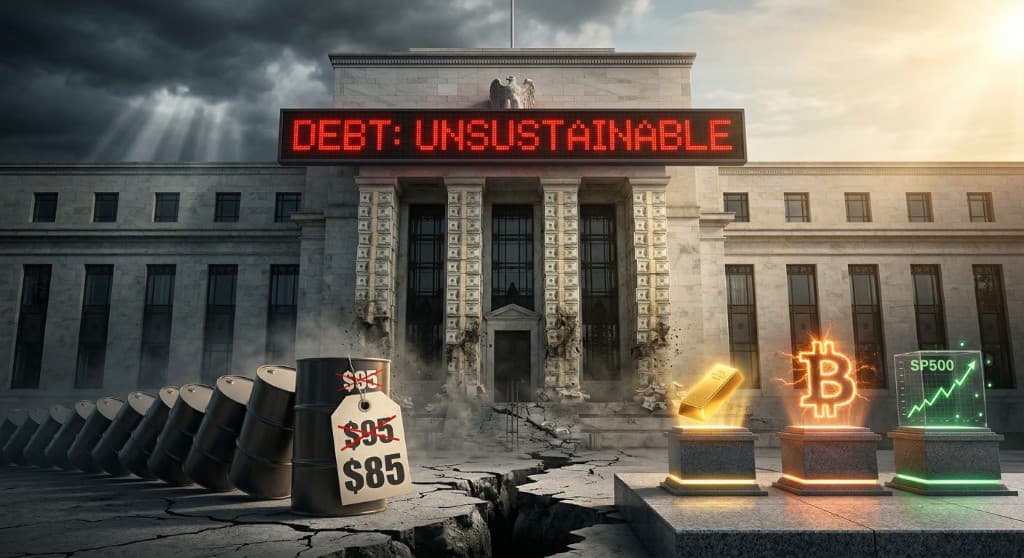
No, the Economy Won't Collapse From Oil Prices — But Powell Just Admitted the Debt Is Unsustainable
The economy won't collapse from $95 oil — the US barely notices, Europe suffers, and the data confirms it. But Powell just said the quiet part loud: US public debt growth is unsustainable. Short-term inflation rises while long-term stays anchored. Short sellers are piling in at levels that historically mark bottoms. The playbook is clear: hard assets — gold, SP500, Bitcoin.
The collapse that isn't coming
The fear du jour: oil prices will crash the global economy. We've heard it for weeks. Media amplifies it. Consumer sentiment reflects it. And the data says: no.
Here's why the economy won't collapse from current oil prices:
- The US is the world's largest oil producer. Higher oil prices help the American economy as much as they hurt it — domestic producers profit, energy sector employment grows, and the trade deficit narrows
- The growth impact is marginal. At current levels (~$95), the US economy slows slightly but continues growing. We're already seeing 2% GDP growth through far worse conditions than oil alone would create
- Oil prices are actually declining from the peak. The conflict highs of $103 are behind us. The futures curve slopes downward. Supply tensions are easing, not worsening
The economy that oil prices can damage is Europe's — because Europe imports everything and has no domestic production to offset the cost. But for the US, this oil "crisis" is more narrative than reality.
Oil at $95 doesn't crash the US economy — the US produces oil. It slows growth from 2.5% to 2.0%. That's an inconvenience, not a catastrophe. The real threat isn't energy prices — it's what Powell just told you about the debt.
Powell says the quiet part out loud
In what might be the most important admission of his tenure, Powell acknowledged that US public debt growth is unsustainable and that monetary policy cannot control inflation caused by supply shocks.
Let those two statements sink in:
1. The debt is unsustainable. This isn't a critic saying it. This isn't a gold bug or a Bitcoin maximalist. This is the Chairman of the Federal Reserve — the person responsible for managing the monetary system — telling you that the fiscal trajectory of the United States is on an unsustainable path.
2. Monetary policy can't fix supply-driven inflation. Rate hikes work on demand. They cool spending, reduce borrowing, slow the economy. But when inflation comes from supply disruption — war, energy shocks, trade disruptions — raising rates doesn't add a single barrel of oil to the market. It just punishes borrowers for a problem they didn't create.
This is the monetary trap made official. The Fed:
- Can't raise rates because the debt makes it prohibitively expensive and it wouldn't fix supply inflation anyway
- Can't cut rates because headline inflation is above target
- Can't stop printing because oil is draining liquidity that must be replaced
- Can't fix the debt because that's Congress's job, and Congress has zero incentive to cut spending
Powell's admission isn't new information for anyone who's been reading our analysis. We've been tracking this trap since the conflict began. But hearing the Fed Chair say it publicly changes the calculus: it's no longer analysis — it's policy.
The inflation picture: split personality
Inflation expectations are telling a nuanced story:
Short-term (1-year): rising, approaching 3%. This makes sense. Oil prices, war disruptions, and supply chain stress create near-term price pressure that consumers and businesses can feel immediately.
Long-term (5-10 year): anchored at ~2.57%. This is crucial. It means the bond market, institutional investors, and professional economists do NOT believe inflation will spiral. They see the current shock as transitory — exactly what we've argued since the beginning of the conflict.
This split is actually the best-case scenario for the Fed's credibility. If long-term expectations were rising, it would signal a loss of confidence in the Fed's ability to eventually control prices. That would force aggressive rate hikes regardless of consequences. But with long-term expectations anchored, the Fed has permission to be patient — to keep rates steady, keep injecting liquidity, and wait for the geopolitical resolution that everyone wants.
The Spanish government's move to reduce hydrocarbon VAT is a perfect illustration of the political dynamic: politicians respond to short-term inflation with short-term fixes that increase long-term debt. It's the same pattern everywhere — spend now, worry later. And the "later" keeps getting closer.
Oil supply: the data contradicts the fear
Beyond the price action, the actual supply data tells an important story:
- Oil prices have decreased from the conflict peak — we went from $103 to below $100, and the trend continues downward
- Market data shows no worsening scarcity — inventories, shipping flows, and refinery utilization don't confirm the apocalyptic supply narratives
- The futures curve remains in backwardation — near-term prices above future prices, but the gap is narrowing, signaling that the market expects normalization
This is consistent with what we've been tracking: physical flows continue despite the conflict. Iran exports through alternative channels. Russia keeps pumping. Saudi Arabia maintains output to its Asian customers. The actual barrels moving through the system tell a different story than the headlines.
The bottom signal strengthens
Every piece of market positioning data points in the same direction: excessive fear creating a setup for reversal.
- Short positions are elevated to levels seen at previous major market bottoms
- Put buying is extreme — fund managers are hedged to the teeth, paying expensive premiums for downside protection
- All 11 sectors have capitulated — the breadth washout already happened
- Consumer sentiment is at 2008 levels while the economy grows at 2%
This is the classic pattern. When everyone is positioned for disaster and disaster doesn't arrive, the unwind is violent. Short covering drives prices up. Puts expire worthless, releasing hedging capital back into the market. Fear flips to FOMO.
We've seen this movie before:
- March 2020: maximum fear, then a 100%+ rally in 12 months
- October 2022: peak bearishness, then a 35% rally through 2023
- October 2023: sentiment washout, then a rally to new all-time highs
The current setup has all the same ingredients. The only missing element is the catalyst — and we have several lined up: peace negotiations, SpaceX IPO, Fed liquidity continuation, and earnings season.
The hard asset playbook
Given everything we've covered — unsustainable debt, monetary trap, supply-driven inflation, excessive fear — the investment thesis writes itself:
Gold
The temporary weakness from Gulf and Turkish selling is creating an entry point. When forced sellers stop and the structural drivers (Chinese accumulation, central bank diversification, dollar debasement) reassert, gold moves to new highs. Powell admitting the debt is unsustainable is the most bullish thing a Fed Chair can say for gold.
SP500
Fear-driven corrections in a growing economy are buying opportunities. The US remains the least affected major economy by the oil shock. Corporate profits are holding. The bottom is likely in, and the catalysts for the rally are multiplying.
Bitcoin
Relatively stronger than both gold and the SP500. Not subject to sovereign forced selling. Benefits from monetary debasement. The Basel III regulatory catalyst is pending. In a world of unsustainable debt and trapped central banks, Bitcoin's fixed supply narrative has never been more relevant.
The common thread: hard assets that can't be printed, debased, or inflated away. Powell just told you the government will keep borrowing and the Fed can't stop it. The logical response is to own things that governments can't create more of.
What to watch
- US PCE inflation data — the Fed's preferred measure; any decline from current levels reinforces the "transitory" thesis and gives the Fed cover to maintain liquidity
- Short interest data — rising short positions at this point become fuel for the rally, not evidence of further downside
- Fed balance sheet weekly releases — confirming continued liquidity injections despite "hold" rhetoric
- European VAT and fiscal measures — tracking how governments respond to inflation with spending, which worsens long-term debt dynamics
- Congressional trades in gold ETFs and Bitcoin — check the CongressFlows dashboard for representatives positioning in hard assets
- Oil inventory reports — weekly EIA data confirming supply isn't collapsing despite conflict narratives
This analysis is based on macroeconomic commentary by José Luis Cava (HOPLA Finance). CongressFlows synthesizes publicly available market analysis to help investors contextualize congressional trading data. This is not financial advice.
Explore the data
Check the latest congressional trades and active investment signals.