Gold Is Dropping Because the Middle East Needs Cash — Not Because the Bull Case Is Over
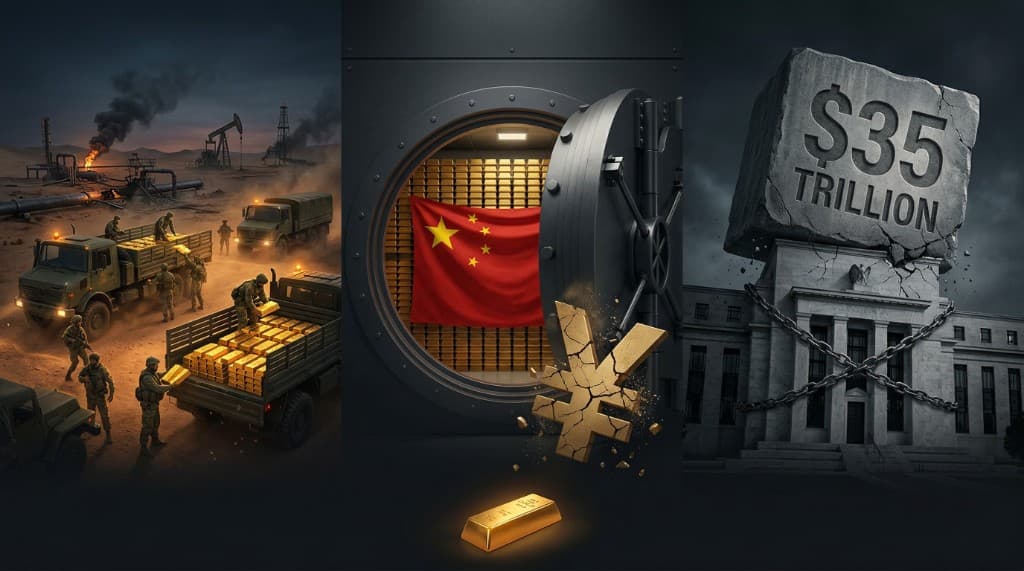
Gold's price drop puzzles investors, but the explanation is simple: Middle Eastern nations are liquidating reserves to fund war costs. Meanwhile, China quietly devalues the yuan and hoards gold, the Fed is trapped by debt, and the real conflict isn't about Iran — it's about China. The long-term gold bull case hasn't changed.
Why gold drops when it "shouldn't"
Every macro textbook says gold should rise during periods of inflation, geopolitical conflict, and monetary uncertainty. We have all three simultaneously — yet gold prices keep falling.
We first explored this paradox when analyzing the mechanics of fund liquidation and Gulf state selling. The picture is now even clearer, and the conclusion is the same: gold is falling for technical and geopolitical reasons, not because its fundamental thesis has weakened.
Understanding this distinction is critical for investors deciding whether the dip is a warning or an opportunity.
The Middle East is selling gold to survive
The primary driver of gold's decline remains forced selling by Middle Eastern nations caught in the ongoing conflict:
- War is expensive — military operations, civilian infrastructure protection, refugee management, and economic stabilization all require immediate cash
- Gold is the most liquid reserve asset — unlike bonds that require a buyer at the right price, or oil that needs functioning export infrastructure, gold can be sold instantly on global markets
- The infrastructure damage compounds the problem — war-damaged oil and gas facilities can't generate revenue while being repaired, creating a cash flow gap that gold sales must fill
- Repair timelines are long — rebuilding energy infrastructure isn't a matter of weeks. Damaged pipelines, processing facilities, and port infrastructure take months to years, meaning the liquidity squeeze on Middle Eastern nations will persist
Gold isn't falling because the world is more stable. It's falling because the countries fighting the war need cash today and gold is the fastest way to get it. That's a temporary technical pressure, not a fundamental shift.
This is the same dynamic we've analyzed from different angles: the Hormuz closure was strategic, the energy infrastructure strikes were economic, and now the financial consequences are playing out through gold markets.
China: devalue the yuan, hoard the gold
While the Middle East sells gold, China is playing the exact opposite game — and understanding why reveals the deeper strategic dynamics at work.
China is simultaneously:
Devaluing the yuan
A weaker yuan makes Chinese exports cheaper and more competitive, partially offsetting the energy cost increases imposed by US control of maritime chokepoints. But there's a more sophisticated motive: currency devaluation reduces the real value of China's debt.
If you owe $1 trillion in yuan-denominated obligations and the yuan loses 10% of its value, your debt burden effectively shrinks. China is using monetary policy as a stealth debt reduction tool while the world focuses on the Middle East.
Accumulating gold
At the same time, China's central bank continues aggressively buying physical gold — as we noted with Chinese citizens queuing at banks, the demand is both institutional and retail.
The strategy is coherent:
- Devalue the currency → reduce debt burden, boost exports
- Accumulate gold → build reserves in an asset that can't be sanctioned, frozen, or devalued by foreign governments
- Reduce dollar dependency → every ounce of gold held is one less dollar needed in reserves
This is a direct counter to US financial hegemony. The dollar's power comes from its role as the global reserve currency. Every time China converts dollars to gold, it chips away at that foundation.
China is playing the long game: weaken the yuan to reduce debt, buy gold while it's cheap from Middle Eastern distress selling, and build a financial fortress that doesn't depend on American goodwill.
The Fed is trapped — and everyone knows it
The central bank analysis we presented in our previous post now gets even starker when you consider the US debt situation.
The Fed cannot aggressively raise interest rates. Here's the arithmetic:
- US public debt exceeds $35 trillion
- Every 1% increase in interest rates eventually adds $350 billion in annual interest payments
- The US already spends more on debt service than on defense
- Military operations in the Middle East are adding to the deficit, not reducing it
- Defense spending requires Fed accommodation, not restriction
The Fed is caught in a trap:
- Raise rates → debt service costs explode → fiscal crisis → forced to cut rates anyway
- Don't raise rates → inflation persists → currency weakens → gold rises eventually
- Print money to fund deficits → monetary degradation → exactly what makes gold valuable long-term
Every path leads back to the same destination: more liquidity, more monetary expansion, more reasons to own gold. The current price drop is a detour, not a destination change.
The real conflict: US vs. China, not US vs. Iran
A recurring theme in Cava's analysis — and one that becomes clearer with each development — is that Iran is not the primary target. China is.
The evidence:
- US control of Hormuz directly threatens China's energy imports, not Iran's
- LNG export strategy positions the US as Asia's energy supplier, displacing Gulf producers that China relied on
- Venezuela's integration into US-aligned supply further reduces China's energy diversification options
- The Hormuz closure was premeditated — designed to demonstrate that China's economy depends on routes the US controls
Iran is the battlefield. China is the target. The objective isn't regime change in Tehran — it's demonstrating to Beijing that energy security requires American cooperation.
China's response — currency devaluation, gold accumulation, pipeline infrastructure investment, nuclear energy expansion — confirms that Beijing understands the strategic reality and is preparing for a world where US maritime dominance is permanent.
The long-term gold thesis is intact
Strip away the short-term noise and the structural case for gold remains overwhelming:
- Central banks can't raise rates meaningfully due to debt levels → real rates stay negative → gold benefits
- Monetary expansion is inevitable → the Fed, ECB, and Bank of England will all eventually inject liquidity → currency debasement → gold benefits
- China keeps buying → persistent demand from the world's second-largest economy provides a structural floor
- Middle Eastern selling is temporary → once the conflict stabilizes and infrastructure rebuilds, the forced selling stops
- Geopolitical uncertainty is permanent → the US-China strategic competition doesn't end with a ceasefire in the Middle East
The current price drop is creating a buying opportunity for investors with a time horizon beyond the immediate conflict. Every ounce being sold by Middle Eastern nations in distress is being absorbed by China, central banks in India and Southeast Asia, and patient institutional investors.
What to watch
- Middle Eastern gold reserve data — central bank disclosures showing the pace of liquidation
- China's PBOC gold purchases — monthly data confirming continued accumulation
- Yuan exchange rate — continued devaluation signals China is pursuing the debt-reduction strategy
- US debt service costs — rising interest payments constrain the Fed's ability to tighten
- Infrastructure repair timelines in the Gulf — longer repairs mean more gold selling but also more oil disruption, which is ultimately gold-positive
- Fed language on rates — any shift toward "patience" confirms the rate trap thesis
This analysis is based on macroeconomic commentary by José Luis Cava (HOPLA Finance). CongressFlows synthesizes publicly available market analysis to help investors contextualize congressional trading data. This is not financial advice.
Explore the data
Check the latest congressional trades and active investment signals.