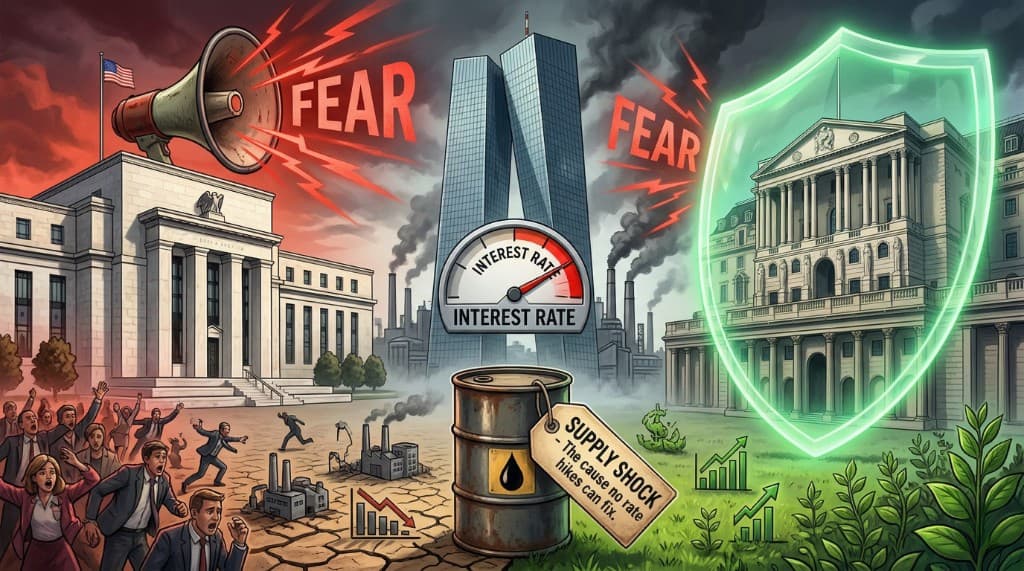
Central Banks Are the Problem: Why Raising Rates During a Supply Shock Is Economic Malpractice
The Fed spreads fear. The ECB signals aggressive rate hikes. But the Bank of England gets it right: this inflation is a supply shock, not demand. Raising rates won't fix expensive oil — it will crush an already slowing economy. Central banks aren't solving the crisis. They're amplifying it.
The biggest source of fear isn't the media — it's central banks
There's an assumption embedded in every market commentary: that fear comes from social media, cable news, or geopolitical headlines. But right now, the single largest source of market anxiety is central banks themselves.
The Federal Reserve, the European Central Bank, and their communications are doing more to destabilize investor confidence than any conflict, headline, or analyst report. Here's why:
- Powell admits he doesn't know — as we covered previously, this admission of uncertainty from the world's most powerful central banker sends a clear signal: the people steering the ship can't see where they're going
- The ECB signals multiple rate hikes — while the economy is already slowing, the European Central Bank is telegraphing an aggressive tightening cycle that markets interpret as tone-deaf
- Inflation expectations rise because central banks are telling everyone to be afraid — creating a self-fulfilling prophecy where fear of inflation generates actual inflation through behavioral changes
The Fed and ECB are supposed to be the adults in the room. Instead, they're the ones shouting "fire" in a crowded theater — and then wondering why everyone is running for the exits.
Supply shock vs. demand inflation: the distinction that changes everything
This is the single most important analytical point in the current environment, and most central bankers are getting it wrong.
Demand-driven inflation
When consumers have too much money chasing too few goods — post-COVID stimulus checks, for example — raising interest rates is the correct response. Higher rates reduce borrowing, cool spending, and bring demand back in line with supply.
Supply-driven inflation
When prices rise because the supply of a critical input has been disrupted — in this case, hydrocarbons due to the Hormuz situation — raising rates doesn't fix anything. You can't drill more oil by making mortgages expensive. You can't reopen a shipping lane by raising the cost of business loans.
The current inflation is overwhelmingly supply-driven. Energy prices have surged ~35% due to geopolitical disruption, and that increase flows through to transportation, manufacturing, food production, and services. This is a cost-push shock, not a demand-pull overheating.
What rate hikes actually do in a supply shock:
- Increase borrowing costs for businesses already squeezed by higher energy bills
- Reduce investment precisely when the economy needs companies to find alternative supply solutions
- Contract credit in an environment where private credit is already stressed
- Strengthen the currency — making exports less competitive while doing nothing about imported energy costs
- Slow the economy without reducing the source of inflation at all
The result: stagflation — simultaneously higher prices AND lower growth. The worst possible outcome, engineered by the very institutions tasked with preventing it.
The Bank of England gets it right
In stark contrast to the Fed and ECB, the Bank of England is adopting a measured, cautious approach that actually aligns with economic reality:
- Acknowledges inflation as temporary — driven by the supply shock, not by domestic demand overheating
- Notes the weak labor market — the UK economy is already slowing, and additional tightening would accelerate the downturn
- Focuses on core inflation — stripping out volatile energy prices to assess underlying price pressures, which remain contained
- Avoids panic signaling — its communications are measured rather than alarmist
This isn't passivity — it's precision. The Bank of England recognizes that you don't treat a supply shock with demand-side tools. It's like prescribing antibiotics for a broken leg: the treatment doesn't match the condition.
The irony: if the Bank of England's approach proves correct — and the inflation spike fades as energy markets normalize, as futures suggest — the UK economy will emerge in better shape than the Eurozone, which will have suffered unnecessary tightening on top of an energy crisis.
The fear feedback loop
Central bank communications have created a destructive feedback loop that amplifies the very problem they claim to be fighting:
- Central banks signal aggressive rate hikes → investors panic
- Investors panic → sell assets, tighten lending standards, reduce risk-taking
- Credit contracts → businesses can't invest, consumers spend less
- Economy slows → unemployment rises, tax revenues fall
- But energy prices haven't changed → inflation remains elevated because the supply shock is external
- Central banks see persistent inflation → signal even more rate hikes
- Loop repeats, each cycle weakening the economy further while inflation persists
This is the textbook definition of a policy error — when the cure causes more damage than the disease.
Rate hikes cure demand inflation. They don't cure supply shocks. Using the wrong tool doesn't just fail to solve the problem — it creates a new one.
What should central banks actually do?
The appropriate response to supply-driven inflation is fundamentally different from the response to demand-driven inflation:
- Communicate clearly that the inflation spike is temporary and supply-driven, reducing inflation expectations rather than amplifying them
- Focus on core inflation (excluding energy and food) as the policy guide — this is what the Bank of England is doing
- Maintain or loosen financial conditions to support businesses navigating higher energy costs
- Coordinate with fiscal policy — targeted subsidies for energy costs are more effective than blanket rate hikes
- Wait — if futures markets are right and oil prices return to ~$85, the inflation spike resolves itself without monetary intervention
The Fed appears to understand this intellectually — Powell's uncertainty suggests internal debate. But the ECB is charging ahead with rate hike signals that could inflict serious damage on an already fragile European economy paying premium energy prices.
What this means for markets
The central bank divergence creates clear investment implications:
Short-term volatility is central-bank-driven
The 50% bearish sentiment we identified isn't primarily about the war or oil — it's about investors fearing a policy mistake. If central banks soften their tone, the relief rally could be swift and powerful.
The ECB is Europe's biggest risk
European equities face a double headwind: expensive energy AND aggressive monetary tightening. Until the ECB changes course, European markets will underperform US markets. Avoid heavy European exposure.
The Fed will pivot before the ECB
The Fed has more flexibility and a stronger economy to work with. Watch for language shifts from "uncertainty" to "patience" — that signals the pivot toward accommodation that we've been anticipating.
Bonds become interesting
If central banks are making a policy error by raising rates during a supply shock, long-duration bonds could rally when the error becomes obvious and rates are cut. The flat 10-year yield may be the market pricing this in already.
What to watch
- ECB forward guidance — any softening of the rate hike trajectory would be a major bullish signal for European assets
- Fed meeting minutes and speeches — internal dissent about rate hikes in a supply shock environment
- Core inflation (ex-energy) — if this remains contained while headline inflation is elevated, it confirms the supply shock thesis
- Bank of England rate decisions — the control experiment. If the UK avoids recession while the Eurozone contracts, the policy error becomes undeniable
- Oil futures curve — continued negative slope confirms the inflation is temporary and rate hikes are unnecessary
This analysis is based on macroeconomic commentary by José Luis Cava (HOPLA Finance). CongressFlows synthesizes publicly available market analysis to help investors contextualize congressional trading data. This is not financial advice.
Explore the data
Check the latest congressional trades and active investment signals.