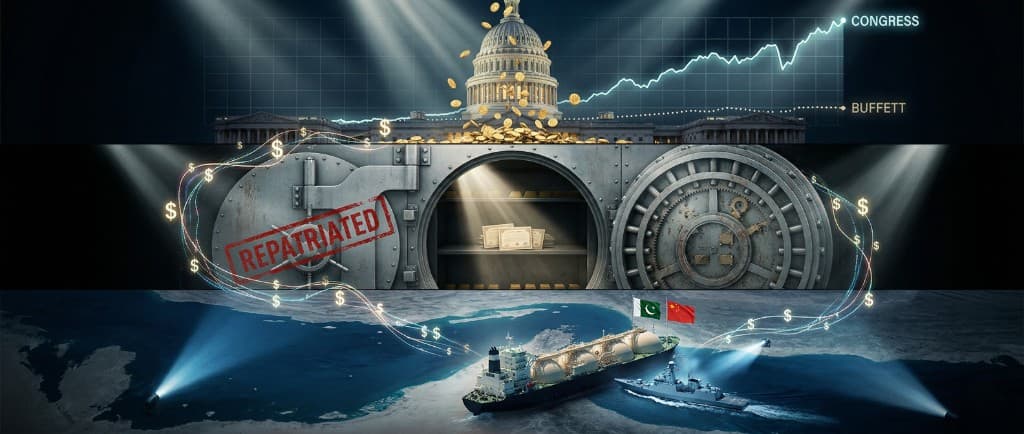
Congress Members Beat Warren Buffett's Returns — And That's Exactly Why CongressFlows Exists
US congress members consistently outperform Warren Buffett in the stock market. Let that sink in. They're not better investors — they have access to information you don't. France's gold repatriation was a smoke-and-mirrors operation. The Fed literally cannot stop printing because debt payments alone require it. And Iran just stopped methane tankers headed to Pakistan and China — revealing negotiations that nobody is supposed to know about.
Congress beats Buffett. That should terrify you.
Here is the single most damning statistic in American finance: US congress members achieve higher average stock returns than Warren Buffett.
Warren Buffett — the greatest investor of the modern era. A man who has spent 70+ years studying markets, building one of the most successful investment vehicles in history, and who has access to the best analysts, the deepest research, and decades of compounding wisdom.
And elected officials with no financial training, no investment infrastructure, and theoretically no informational advantage... beat him.
There are only two possible explanations:
1. Congress members are secretly the greatest investors who ever lived
They just happen to have a supernatural talent for stock picking that exceeds the Oracle of Omaha, and they modestly chose careers in public service instead of managing hedge funds.
2. They trade on insider information
They sit on committees that regulate industries. They receive classified briefings on economic threats. They vote on legislation that directly impacts stock prices. They know which companies will get government contracts, which sectors will face regulation, and which policies will move markets — before the public does.
There is no third explanation.
Congress members outperform Warren Buffett in the stock market. They're not better investors. They sit on the committees that write the rules, receive the briefings, and vote on the legislation that moves prices. This isn't investing — it's legalized front-running.
This is exactly why we built CongressFlows. Every trade disclosed by a senator or representative is a potential signal. Not because their analysis is superior, but because their information is. The STOCK Act of 2012 requires disclosure, but the 45-day window gives them more than enough time to profit before you even know they traded.
The solution is obvious: mandatory disclosure within 24 hours, or better yet, real-time. If congress members had to report trades the same day, the informational advantage would evaporate. The public could see what insiders are buying and selling in near real-time, and prices would adjust accordingly.
Will this happen? Not as long as the people who benefit from the current system are the same people who would need to vote to change it.
France's gold magic trick
In a story that received remarkably little attention, the French Central Bank announced it had "repatriated" gold reserves. Sounds prudent, right? Bringing your gold home in uncertain times.
Except that's not what happened. The operation was:
- Sell old gold bars (held in France) that didn't meet current international purity and weight standards
- Buy new gold bars that meet London Good Delivery specifications
- Announce this as "repatriation" to the public
The net result? No change in gold holdings. No real profit. A public relations win disguised as financial prudence.
But the deeper question is more troubling: where is France's gold actually stored?
A significant portion of French gold reserves is held at the Federal Reserve Bank of New York and the Bank of England — the same vaults where Germany famously tried (and struggled) to repatriate its gold in 2013. Germany's request to bring home 674 tons took seven years and raised serious questions about whether the gold was actually there or had been leased, rehypothecated, or otherwise encumbered.
If France is performing accounting tricks to update the quality of its bars rather than physically moving gold to French soil, it suggests either:
- The gold can't easily be moved (it's committed elsewhere)
- The political will to challenge the US-UK custody arrangement doesn't exist
- The announcement was purely for domestic political consumption
For gold investors, the takeaway: central bank gold accounting is opaque by design. The physical gold market and the paper gold market operate on different planes, and the gap between "gold we say we have" and "gold we can actually deliver" may be wider than any official statement suggests.
The Fed literally cannot stop printing
Cava crystallizes something we've been building toward for weeks: the Federal Reserve's balance sheet reduction isn't just unlikely — it's mathematically impossible.
Here's the arithmetic of the US debt trap:
- Social spending continues to grow with an aging population
- Defense spending has surged due to the Iran conflict and ongoing global commitments
- Interest payments on existing debt are now one of the largest line items in the federal budget — and they grow every time rates stay elevated
The sum of these three obligations exceeds what the government can fund through taxation alone. The deficit must be financed by borrowing. And borrowing at scale requires a buyer of last resort for Treasury bonds.
That buyer is the Federal Reserve.
If the Fed reduces its balance sheet (QT), it's simultaneously:
- Removing a major buyer of Treasuries
- Forcing the Treasury to find other buyers at higher yields
- Increasing the government's interest expense
- Making the deficit worse
- Requiring even more borrowing
- Which requires even more Fed buying
It's a circular trap with no exit. Powell admitted the debt is unsustainable. What he didn't say — but what the math shows — is that the Fed is permanently committed to monetizing the debt, regardless of what they call it.
The Fed says it will reduce its balance sheet. But US debt grows faster than GDP, interest payments consume an ever-larger share of the budget, and only the Fed can buy Treasuries at the scale needed. QT isn't a choice — it's a fantasy. The printing never stops.
This is why hard assets aren't just a trade — they're a structural necessity. In a system where the central bank must perpetually expand its balance sheet to keep the government solvent, every asset priced in dollars is gradually diluted. Gold, Bitcoin, and productive equities are the rafts in a slowly rising sea.
Hormuz: Iran stops methane tankers to allies
In a development that reveals the complexity of behind-the-scenes negotiations, Iran's Revolutionary Guard intercepted methane tankers destined for Pakistan and China — two countries that are nominally Iran's allies and actively mediating the peace process.
Why would Iran stop gas shipments to its own allies?
Several possible interpretations:
Negotiating pressure
Iran is demonstrating to Pakistan and China that it still controls the strait and can affect their energy supplies. This is leverage — a reminder that any peace deal must address Iran's core interests, not just the US agenda.
Internal power struggles
The Revolutionary Guard operates semi-independently from Iran's civilian government. Stopping allied shipments could be a signal that the Guard disagrees with the pace or terms of negotiations — using operational actions to influence diplomatic outcomes.
Staged demonstration
The interception may have been coordinated with Pakistan and China as a public demonstration of Iran's capability — a negotiating theater piece designed to strengthen Iran's position before the Islamabad summit.
Regardless of the true motivation, the market's reaction is telling: oil prices remain stable. The market has fully internalized that Hormuz incidents are noise, not signal. Price spikes from headline risk are immediately faded.
This immunity to geopolitical headlines is itself a bottom signal. When bad news can't push prices lower, the downside is exhausted.
Connecting the dots
Today's analysis connects four seemingly disparate themes into a single coherent picture:
- Congress trades on inside information → The system is rigged for those with access
- France performs gold accounting tricks → Central banks operate on opacity, not transparency
- The Fed can't stop printing → The monetary system is structurally degrading
- Iran intercepts allied shipments → Geopolitical negotiations are more complex than public narratives suggest
The common thread: the official version of events is never the complete version. Markets are manipulated. Gold reserves are opaque. Money printing is disguised. Negotiations happen in shadows.
For investors, the response is the same as it's been throughout this series: own assets that can't be manipulated, don't rely on official narratives, and use tools like CongressFlows to see what the insiders are actually doing with their money.
What to watch
- Congressional trading disclosures — we're now entering the window where trades around Trump's March 24 tweet should start appearing. Check the CongressFlows dashboard regularly
- STOCK Act reform proposals — any legislative movement toward same-day disclosure would be transformative for market transparency
- Fed balance sheet weekly data — track whether the Fed is actually reducing or quietly expanding through backdoor channels
- European central bank gold audits — any requests for physical verification or repatriation signal declining trust in the custodial system
- Hormuz methane/LNG flow data — tracking which shipments are blocked and which pass reveals the true state of negotiations
- Oil price reaction to headline events — diminishing volatility on negative news confirms the market's immunity and the bottom thesis
This analysis is based on macroeconomic commentary by José Luis Cava (HOPLA Finance). CongressFlows synthesizes publicly available market analysis to help investors contextualize congressional trading data. This is not financial advice.
Explore the data
Check the latest congressional trades and active investment signals.