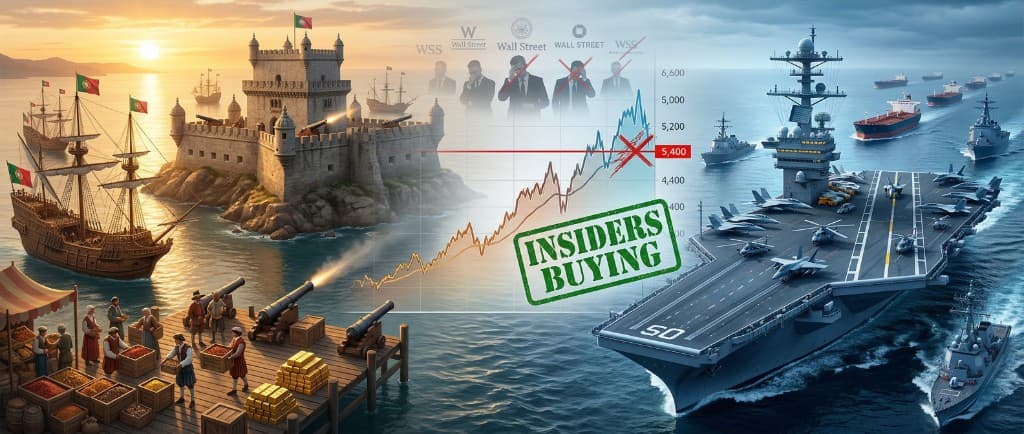
Goldman Says SP500 to 5,400. Buffett Agrees. Insiders Are Buying Tech. — Someone Is Wrong.
Goldman Sachs, Warren Buffett, and Michael Hodel all predict the SP500 drops to 5,400-5,500. But corporate insiders are buying tech stocks at a pace that historically marks bottoms, and the market is hedged to the teeth. When everyone is positioned for the crash, the crash doesn't come. The real drop comes later — when a new president tests the market's liquidity. Plus: what 16th-century Portugal's control of Hormuz tells us about today's energy wars.
The big names want you to sell
The heavyweights have spoken:
- Goldman Sachs projects the SP500 falling to ~5,400
- Warren Buffett has been accumulating cash, signaling bearish expectations
- Michael Hodel echoes the same range: 5,400-5,500
When Goldman, the Oracle of Omaha, and prominent analysts converge on the same target, retail investors panic. They sell. They buy puts. They move to cash. The narrative becomes self-reinforcing: smart money says sell, so I should sell.
But here's what the narrative misses: the market doesn't crash when everyone is expecting it to.
The hedging paradox
The current positioning data tells a story that contradicts the crash thesis:
- Put buying is at extreme levels — fund managers are paying record premiums for downside protection
- Short positions are elevated — we've tracked this across multiple posts as a bottom signal
- Cash allocations are high — Buffett isn't alone; institutional cash levels rival 2020 and 2008
- Consumer fear is at crisis levels — everyone is already positioned defensively
When the entire market is hedged for a crash, who's left to sell? The sellers have already sold. The hedgers have already hedged. The shorts are already short.
For the SP500 to reach 5,400, you need a new wave of selling — fresh panic from investors who haven't yet positioned defensively. But there are almost none left. The all-11-sectors-red capitulation already flushed them out.
Goldman says 5,400. Buffett hoards cash. Analysts are bearish. Put buying is extreme. Everyone is hedged. But that's exactly why the crash won't come now — markets don't crash when everyone is already wearing a parachute.
Insiders are buying — and they know more than you
While the big names issue public warnings, something quieter and far more telling is happening: corporate insiders are buying their own tech stocks.
This is the signal that matters most. Here's why:
CEOs, CFOs, and board members have access to material non-public information about their companies. They see the order books. They know the pipeline. They understand the margins. When they buy their own stock, they're making a statement with their own money: our stock is undervalued.
The current insider buying pattern in technology stocks is consistent with previous major market bottoms:
- Before the March 2020 bottom, insider buying spiked
- Before the October 2022 bottom, insiders accumulated aggressively
- Before every significant reversal, the people who actually run the companies bought while the analysts told everyone to sell
This is exactly what CongressFlows tracks at the political level — but corporate insiders do the same thing. When people with asymmetric information are buying while public commentators are selling, follow the information, not the commentary.
The divergence between public bearishness (Goldman, Buffett) and private buying (insiders) is historically one of the most reliable contrarian indicators. The public warnings serve a purpose — they create the fear that pushes prices to levels where informed buyers want to accumulate.
The "real" drop: a matter of timing
The analysis suggests the significant market correction will come — but not now. The expected timeline:
The catalyst: a new US president testing the market.
Every new administration tests the financial system's tolerance. They inherit a market, and before implementing their own policies, they allow or even engineer a correction to:
- Reset expectations — blame the previous administration for any decline
- Test the Fed's response — see how quickly and aggressively the Fed injects liquidity
- Create a lower base — so future gains can be attributed to the new president's policies
- Shake out weak hands — force selling that creates buying opportunities for allied interests
When this happens, the market won't be hedged for it. The current protective positioning will have expired. Puts will have decayed. Cash will have been redeployed. And that's when the drop hits — when nobody is expecting it anymore.
The playbook for investors: the bottom we've been tracking since the false breakout is the near-term bottom. The rally comes first. The real correction comes later, from higher levels, and catches people off guard.
Hormuz: when Portugal controlled the world's chokepoint
In a fascinating historical parallel, Cava traces the strategic importance of the Strait of Hormuz back five centuries — and the parallels with today are striking.
Portugal's maritime empire
In the early 1500s, Portugal established control over the world's key maritime chokepoints: the Cape of Good Hope, the Strait of Malacca, and critically, the Strait of Hormuz. The strategy was identical to what the US does today:
- Control the passage, control the trade. Portugal didn't need to conquer entire countries. It just needed to hold the narrow points through which all commerce flowed
- Tax everything that passes. Portuguese fortifications at Hormuz collected duties on every ship transiting between Asia and Europe — spices, silk, gold, and precious stones
- Military presence as deterrent. The Portuguese navy maintained enough force to discourage challenges from regional powers
The revenue was enormous. Hormuz's taxation filled Portuguese and later Spanish coffers, financing wars, cathedrals, and empire-building across four continents.
How empires lose chokepoints
Portugal's loss of Hormuz offers a cautionary tale:
- Declining investment — as revenue flowed to Lisbon, reinvestment in Hormuz's defenses declined. The fortifications crumbled. The garrison shrank.
- Internal conflicts — Portuguese politics diverted attention from maintaining distant outposts. Factional struggles consumed resources that should have sustained the empire's periphery.
- Rising competitors — Persia, supported by England (the emerging maritime power), saw the opportunity. Shah Abbas allied with the English East India Company to expel the Portuguese in 1622.
- The domino effect — losing Hormuz weakened Portugal's entire Indian Ocean network, contributing to the cascade that eventually led to Portuguese separation from Spain in 1640.
The modern parallel
Replace "Portugal" with "the United States" and the structural pattern is familiar:
- A maritime power controls Hormuz through military presence
- The revenue (now measured in energy pricing power rather than direct taxation) is enormous
- Competitors (now China and Russia rather than Persia and England) probe for weakness
- The cost of maintaining control rises while domestic political will fluctuates
The critical difference: the US in 2026 has a military capability that 16th-century Portugal could never have imagined. But the strategic principle remains — chokepoints are only valuable as long as you can hold them, and the cost of holding them must be less than the revenue they generate.
Portugal controlled Hormuz for a century and got rich from it. Then it stopped investing, got distracted by internal politics, and lost it to Persia backed by England. Five centuries later, the US controls the same strait, faces the same strategic calculus, and the same competitors are circling. History doesn't repeat, but it rhymes — especially at chokepoints.
Cultural echoes
The wealth flowing through Hormuz left marks on Spanish literature and culture. Quevedo, Comella, and Rubén Darío all referenced the strait's riches — evidence of how deeply the control of a single maritime passage shaped an entire civilization's self-image. When we talk about Hormuz today in the context of energy dominance and geopolitical control, we're participating in a conversation that's been ongoing for half a millennium.
What to watch
- Insider buying data (SEC Form 4 filings) — continued tech insider accumulation strengthens the case that 5,400 is not the destination
- Goldman Sachs' own positioning — watch what Goldman does (their trading desk activity) versus what Goldman says (their public research)
- Put option open interest — declining puts signal the hedging is expiring, which paradoxically makes the market more vulnerable later
- Congressional trades in tech stocks — check the CongressFlows dashboard for representatives buying the same tech names that corporate insiders are accumulating
- New administration policy signals — any language about "inherited economic challenges" is the setup for the engineered correction
- SP500 at 6,470 resistance — a break above kills the 5,400 thesis entirely and forces short covering
This analysis is based on macroeconomic commentary by José Luis Cava (HOPLA Finance). CongressFlows synthesizes publicly available market analysis to help investors contextualize congressional trading data. This is not financial advice.
Explore the data
Check the latest congressional trades and active investment signals.