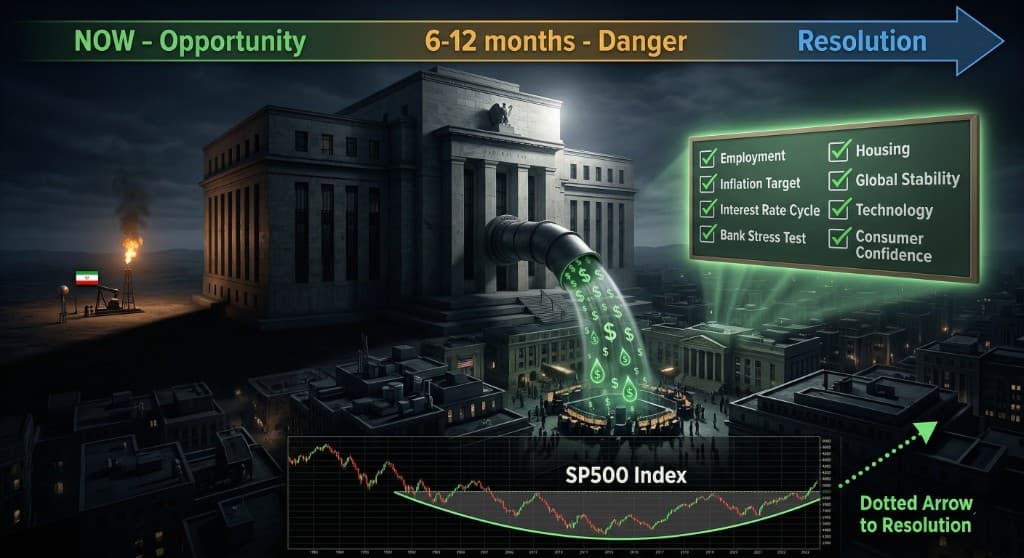
The Fed's Balance Sheet Is a Bigger Threat Than Iran — And the Market Bottom Is Here
Everyone is watching Iran. But the real threat to markets is sitting in the Eccles Building: the Fed's plan to drain $1-2 trillion from its balance sheet. That liquidity contraction would crush credit, hammer emerging markets, and make the Iran conflict look like a footnote. Meanwhile, Trump's war strategy is delivering exactly what it was designed to: US energy dominance, agricultural export growth, and a weakened Iran that's losing leverage by the day.
The threat nobody is watching
The entire financial media is fixated on Iran. Every headline, every ticker crawl, every analyst note — it's all about the conflict, the oil price, the geopolitical risk.
But the actual threat to your portfolio isn't in the Strait of Hormuz. It's in the Federal Reserve's balance sheet.
The Fed holds somewhere between $7-8 trillion in assets accumulated through years of quantitative easing. The plan to reduce this by $1-2 trillion — quantitative tightening (QT) — represents a liquidity drain of historic proportions.
Here's what QT actually does:
- Drains reserves from the banking system — banks have less money to lend
- Contracts credit availability — businesses and consumers face tighter borrowing conditions
- Raises real interest rates — even without the Fed hiking, reduced liquidity pushes rates higher
- Hammers asset prices — stocks, bonds, real estate, and crypto all depend on liquidity. Remove it, and gravity takes over
- Devastates emerging markets — dollar liquidity contraction forces capital back to the US, triggering currency crises in vulnerable economies
The Iran conflict might move oil $10 in either direction. The Fed's balance sheet reduction could move everything 20-30% lower. The scale isn't comparable.
Everyone is watching Iran. But a $1-2 trillion Fed balance sheet reduction would drain more liquidity from markets than a dozen Middle East conflicts combined. The real threat isn't in the Strait of Hormuz — it's in the Eccles Building.
Why QT hasn't happened yet (and may not)
Here's the critical nuance: the Fed plans to reduce the balance sheet, but actually executing that plan is another matter entirely.
We've been tracking the monetary trap for weeks:
- Powell admitted the debt is unsustainable — reducing the balance sheet while government borrowing accelerates creates a collision between fiscal and monetary policy
- Oil is draining liquidity from the financial system — adding QT on top of energy-driven drainage could trigger a credit freeze
- The economy is growing at only 2% — aggressive QT risks tipping that into contraction
- SpaceX needs a bull market for its IPO — powerful interests are aligned against liquidity withdrawal
The most likely outcome: the Fed talks about QT but doesn't follow through at scale. It reduces the balance sheet gradually, pauses at the first sign of market stress, and eventually reverses course. This is exactly what happened in 2018-2019 — the Fed attempted QT, markets sold off 20%, and the Fed capitulated.
The risk isn't that QT happens aggressively. The risk is the threat of QT creating uncertainty that suppresses valuations while the Fed figures out how to back down without losing credibility.
For investors, the playbook is clear: own hard assets that benefit when the Fed inevitably reverses. Gold, Bitcoin, and SP500 are the beneficiaries when QT fails and liquidity resumes.
The SP500 bottom: the evidence stacks up
Every week brings more confirmation that the market bottom is forming:
| Signal | Status | |--------|--------| | All 11 sectors red | Confirmed | | Consumer fear at 2008 levels | Confirmed | | 50% bearish individual investors | Confirmed | | Extreme put buying | Confirmed | | Corporate insiders buying tech | Confirmed | | Oil declining from peak | Confirmed | | Peace timeline: 4 months | On track | | Inflation + bond yields stabilizing | Confirmed (new) |
The latest data point: inflation and bond yields are stabilizing despite the geopolitical tensions. This is the market's way of confirming that the supply-driven inflation is transitory and that the bond market continues to see through the noise.
Inflation stabilizing means the Fed has no reason to hike. Bond yields stabilizing means the market isn't pricing in a credit crisis. Both conditions are necessary for the bottom to hold and the rally to begin.
The Goldman/Buffett 5,400 target we analyzed last post looks increasingly unlikely as the near-term destination. The bottom is here. The rally is loading.
Trump's Iran strategy: follow the money
Strip away the moral dimensions and the media noise. Look at what Trump's Iran strategy has actually delivered in economic terms:
Energy sector wins
- US oil producers benefit from elevated prices — every dollar above $80 is windfall profit for domestic production
- LNG exports to Europe surge — the conflict reinforces European dependency on American gas
- Energy sector employment grows — creating political capital in key states
Agricultural exports boom
- Asian semiconductor supply chains disrupted — but US agricultural exports fill a different gap. The conflict has disrupted fertilizer supplies from the Middle East, and the US is positioning as an alternative supplier
- Food security becomes leverage — countries dependent on Middle Eastern fertilizers now look to US sources, creating long-term trade relationships
Iran's weakening position
Iran's negotiating leverage is eroding daily:
- Allowing certain oil shipments — this isn't strength, it's accommodation. Iran is making concessions to keep revenue flowing, which signals desperation, not control
- Alternative shipping routes emerging — other nations are finding ways to bypass Hormuz entirely, reducing Iran's strategic chokepoint value
- All parties want the war to end — but Iran's bargaining chips are shrinking faster than anyone else's
The US emerges from this conflict with stronger energy exports, new agricultural trade relationships, a weakened adversary, and a defense industry stimulus. Whatever you think about the morality, the economics are undeniable.
War dips: the pattern investors must learn
Cava highlights a pattern that every investor should internalize: war-driven market dips are historically buying opportunities, not selling signals.
The data is overwhelming:
- Gulf War (1991): markets dipped on invasion, rallied throughout the conflict
- 9/11 and Afghanistan (2001): sharp dip, followed by recovery within months
- Iraq War (2003): SP500 bottomed before the invasion and rallied through the war
- Crimea (2014): brief dip, no sustained impact
- Ukraine (2022): market bottomed within weeks of the invasion
The pattern: markets price in the worst case immediately, then recover as the worst case fails to materialize. The initial shock creates the buying opportunity. The prolonged conflict becomes background noise that markets learn to ignore.
The current Iran conflict follows the same script. The initial shock drove the dip. Markets have now moved sideways for weeks, absorbing the news without making new lows. The next move is up — triggered by the peace catalyst that's approaching.
The real timeline of risk
Putting it all together, the risk timeline looks like this:
Now → 3-4 months: Market bottom holds. Rally builds as peace negotiations progress. SP500 moves toward and potentially above recent highs. Energy and agriculture sectors outperform. This is the opportunity window.
6-12 months: New administration takes power. Tests the market. The Fed faces the QT decision seriously. This is the danger window — the correction that insiders are positioning for by holding cash now.
12+ months: Resolution. Either the Fed capitulates on QT (bullish for everything), or follows through (bearish until they stop). History says they capitulate.
The mistake most investors make: being bearish during the opportunity window because they're afraid of the danger window. The right move is to participate in the rally, then reassess when the new administration signals its intentions.
What to watch
- Fed meeting minutes and QT language — any softening of balance sheet reduction timeline is massively bullish
- SP500 bond yield correlation — stabilizing yields with rising equities confirms the bottom thesis
- US agricultural export data — growth confirms the strategic benefit from the conflict
- Iran oil shipment concessions — more accommodations signal weakening leverage and approaching peace deal
- Congressional trades in energy and agriculture — check the CongressFlows dashboard for representatives on agriculture and energy committees positioning ahead of the policy shifts
- Emerging market currencies — weakness would be the canary in the coal mine for QT actually biting
This analysis is based on macroeconomic commentary by José Luis Cava (HOPLA Finance). CongressFlows synthesizes publicly available market analysis to help investors contextualize congressional trading data. This is not financial advice.
Explore the data
Check the latest congressional trades and active investment signals.