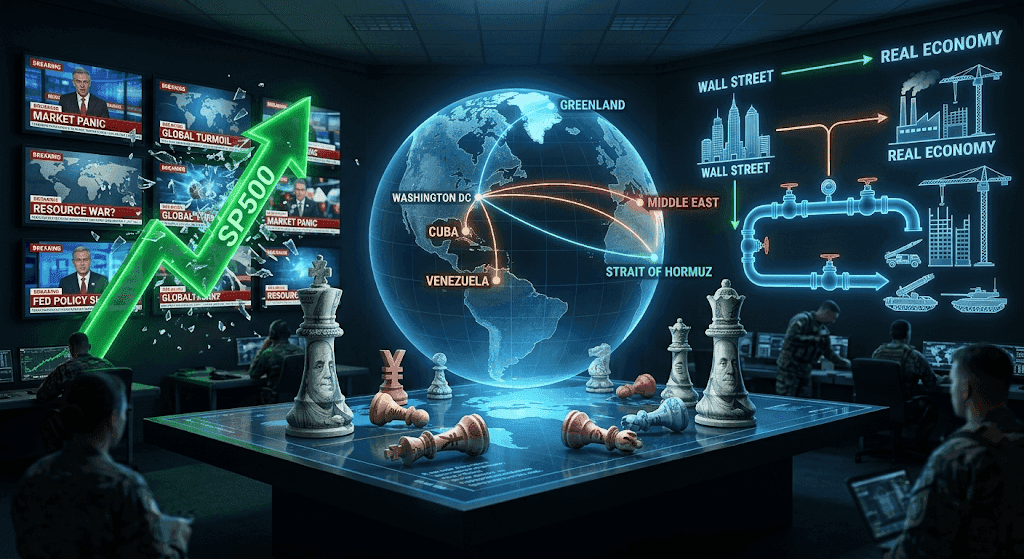
Trump Is Using Chaos as Strategy — And the Dollar, the Market, and the Defense Industry Are All Winning
Tariffs, territorial ambitions, discredited institutions — it looks like chaos. But it's a strategy. The dollar is strengthening, not weakening. The SP500 bounced back from every media-driven panic. And the next mega-trend is emerging: Wall Street money flowing into defense, reconstruction, and real-economy infrastructure from the Middle East to Venezuela. The chaos IS the plan.
Chaos as strategy
From the outside, Trump's policy agenda looks like a wrecking ball swinging randomly: tariffs here, territorial claims there, international organizations undermined everywhere. The media presents it as incompetence, impulsiveness, or both.
But step back and a pattern emerges. Every move serves a strategic objective:
- Tariffs → Signal that the rules of global trade have changed. Force renegotiation of terms that favor US interests. Accept short-term pain for long-term leverage
- Greenland, Venezuela, Cuba → Secure the US perimeter from the Arctic to the Gulf of Mexico. Control strategic resources (rare earths, oil, geographic chokepoints)
- Discrediting international organizations → Weaken multilateral frameworks that constrain US unilateral action. Reduce the influence of institutions where China and Russia have gained leverage
- Military action in Iran → Control energy flows, demonstrate power projection, and stimulate the defense economy
None of these are random. They're elements of a coherent — if aggressive — strategy to reshape the world order in America's favor during a window of relative strength.
Tariffs, territorial claims, institutional sabotage, military operations — it looks like chaos from the headline level. But from the strategic level, every move serves the same goal: maximum American leverage before the next shift in global power. The chaos IS the plan.
The question isn't whether you agree with the strategy. It's whether you're positioned for it.
The dollar wins the chaos game
Here's the data point that demolishes the "America is declining" narrative: the US dollar has strengthened through all of this.
Despite tariffs that should theoretically weaken trade. Despite a military conflict that should drain resources. Despite debt levels that Powell himself called unsustainable. The dollar is stronger.
Why?
Safe haven flows
When the world gets chaotic, capital doesn't flee the US — it flees to the US. The dollar remains the ultimate safe haven because:
- US Treasury bonds are still the most liquid asset on the planet
- The US military guarantees the global order that underpins dollar dominance
- No alternative currency can match dollar liquidity at scale
China's yuan isn't ready
The yuan's share of global reserves remains limited. China maintains capital controls that prevent free convertibility. The digital yuan is a domestic tool, not an international reserve currency. Until China opens its capital account — which would expose its banking system to forces it can't control — the yuan isn't a real alternative.
The Fed's printing is global stimulus
When the Fed injects liquidity, it doesn't just stimulate the US economy. Dollars flow globally through trade, investment, and financial markets. Every country that borrows in dollars needs dollars to service that debt. The Fed's printing actually increases global dollar demand in the short term — a paradox that strengthens the currency even as its supply grows.
This is the monetary equivalent of "too big to fail." The dollar's dominance creates demand for dollars, which sustains the dominance, which creates more demand. The cycle breaks only when a credible alternative emerges — and one hasn't.
The SP500: panic sold, reality bought
The media playbook during this period has been consistent: amplify fear, trigger selling, then the market recovers.
We've documented this pattern repeatedly:
- Coordinated media leaks that contained no new information
- Iran's headline manipulation triggering a false breakout
- Analysts predicting SP500 at 5,400 while insiders bought
- Consumer fear at 2008 levels while the economy grew at 2%
And every time, the SP500 recovered. The panic was sold. The reality was bought.
This resilience isn't random — it's structural:
- The Fed keeps printing — liquidity provides a floor under asset prices
- Corporate earnings hold up — despite headlines, American companies continue generating profits
- The US is net benefiting from the conflict — energy exports, defense spending, agricultural trade
- Insider and institutional buying absorbs every fear-driven dip
The lesson: don't trade the narrative — trade the positioning. The narrative says fear. The positioning says bottom.
The great rotation: Wall Street to Main Street
Here's the most important forward-looking insight from today's analysis: investment flows are shifting from financial assets to real-economy infrastructure.
The next wave of capital deployment will flow into:
Defense rebuilding
Every missile fired, every ship deployed, every surveillance system activated needs to be replaced and upgraded. Defense procurement cycles take years, creating a multi-year investment theme in:
- Aerospace and defense contractors
- Semiconductor companies serving military applications
- Cybersecurity firms
- Logistics and supply chain companies
Middle East reconstruction
When the peace deal arrives — and the market says it will — the reconstruction contracts will be enormous:
- Infrastructure rebuilding (power, water, communications)
- Energy sector rehabilitation
- Construction materials and heavy equipment
- Engineering and project management firms
The companies that win these contracts will be predominantly American. This is part of the strategy — the war creates the destruction, the peace creates the contracts, and US companies capture both.
Venezuela and Cuba
US strategic interest in both countries extends beyond rhetoric:
- Venezuela: world's largest proven oil reserves, currently underproduced due to sanctions and mismanagement. US involvement would mean massive investment in production infrastructure
- Cuba: geographic position controls access to the Gulf of Mexico. Normalization would open a new market 90 miles from Florida
The investment implication
The rotation from financial speculation to real-economy investment means:
- Value over growth for the next cycle — companies that build things outperform companies that trade things
- Commodities and industrials outperform pure-play tech
- Emerging market infrastructure plays become relevant once the geopolitical dust settles
- Defense remains a core holding regardless of peace or war — the rebuilding cycle lasts longer than the conflict
Positional analysis: the third dimension
Cava introduces an important concept: positional analysis as a complement to fundamental and technical analysis.
- Fundamental analysis tells you what an asset is worth
- Technical analysis tells you what the market thinks it's worth
- Positional analysis tells you who is positioned and how
When everyone is short and hedged, the risk is to the upside. When insiders are buying, the smart money disagrees with the public narrative. When the media drives panic but the market recovers within hours, the manipulation is exposed.
CongressFlows is fundamentally a positional analysis tool — it shows you what the most informationally advantaged players are doing, not what they're saying. And right now, the positional data says: the bottom is in, the rally is coming, and the smart money is already positioned.
What to watch
- Tariff negotiations and trade deal announcements — any bilateral deal signals the "chaos" phase transitioning to the "new order" phase
- Greenland/Venezuela/Cuba diplomatic developments — actual moves toward securing these territories confirm the strategic framework
- Dollar index (DXY) — continued strength validates the "dollar wins chaos" thesis
- Defense contractor earnings and guidance — forward guidance will reveal the multi-year procurement pipeline
- Reconstruction-related ETFs and stocks — early positioning in infrastructure, materials, and engineering companies
- Congressional trades in defense, energy, and infrastructure — check the CongressFlows dashboard for committee members positioning ahead of contract announcements
This analysis is based on macroeconomic commentary by José Luis Cava (HOPLA Finance). CongressFlows synthesizes publicly available market analysis to help investors contextualize congressional trading data. This is not financial advice.
Explore the data
Check the latest congressional trades and active investment signals.