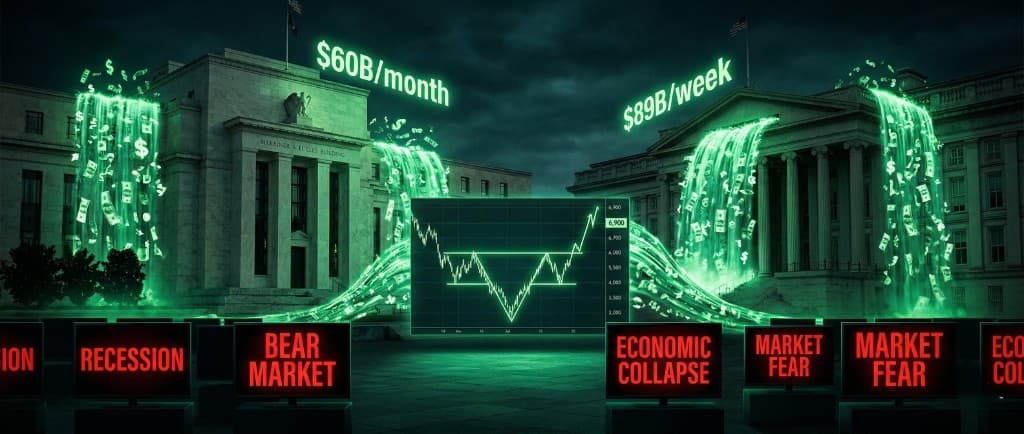
$100 Billion in One Week: The Fed and Treasury Liquidity Bomb That Media Ignored While SP500 Hit 6,900
The Fed injected $15 billion per week in bills. The Treasury dumped $89 billion into the system in a single week before April 8. Combined: over $100 billion in one week. The SP500 completed an inverted head and shoulders and hit 6,900. No major outlet reported it. Since 2008, markets follow liquidity, not earnings. This is the playbook — and they don't want you to see it.
The credit system is cracking — and they're papering over it
The US credit system is deteriorating. Private credit markets are showing stress. Loan portfolios are under pressure. Apollo's problems were the canary — the stress has since spread beyond software into broader sectors.
Under normal circumstances, credit deterioration contracts liquidity. Less lending, less money circulating, stocks fall. That's the textbook.
But we don't live in textbook markets anymore.
Since 2008, market movements depend more on liquidity than corporate profits. Central banks rewrote the rules. If you're still analyzing earnings to predict markets, you're reading the wrong book.
The double injection they didn't tell you about
Here's what happened in the first week of April 2026, behind the curtain:
The Federal Reserve: $15 billion/week
The Fed has been quietly purchasing Treasury bills at a steady pace — approximately $15 billion per week, totaling around $60 billion per month. This is not QE in name — they're careful to avoid that label — but the effect on system liquidity is identical: money enters the financial system, asset prices rise.
This has been ongoing. Consistent. Unreported by mainstream financial media.
The US Treasury: $89 billion in one week
In the week leading up to April 8, 2026, the US Treasury injected an extraordinary $89 billion into the financial system. This was done through Treasury General Account (TGA) drawdowns — effectively releasing cash that had been sitting dormant.
Combined with the Fed's weekly bill purchases: over $100 billion in a single week.
The result
The SP500 formed a textbook inverted head and shoulders pattern — one of the most reliable bullish reversal signals in technical analysis — and rallied to 6,900 points.
This wasn't magic. This wasn't the market "figuring out" that the economy is fine. This was $100 billion of fresh liquidity flowing into a system that was positioned short and fearful.
The pattern we identified was there for anyone tracking liquidity flows. The false breakout at 6,361 was the left shoulder. The 11-sector capitulation was the head. And the recovery was the right shoulder completing the pattern before the breakout.
Since 2008: liquidity IS the market
This is the fundamental truth that most retail investors still haven't internalized:
Since the 2008 financial crisis, markets don't move on earnings. They move on liquidity.
Every major rally since 2008:
- 2009-2020: Fed QE1, QE2, QE3, and QE-infinity
- 2020-2021: $5 trillion pandemic stimulus
- 2023-2024: Stealth liquidity through bank bailouts (SVB/BTFP program)
- 2025-2026: Bill purchases + TGA drawdowns during Iran conflict
Every major decline:
- 2018 Q4: Fed attempted balance sheet reduction → market crashed → Fed reversed
- 2022: Fed hiked rates and attempted QT → worst bond market in decades
- Late 2025: Liquidity tightening fears → the decline we just recovered from
The correlation between central bank balance sheets and stock prices since 2008 is almost perfect. This is why our thesis — that the Fed can't stop printing — is the single most important investment thesis of this era.
The balance sheet threat we flagged as the real danger? It's real. If the Fed actually reduced its balance sheet by $1-2 trillion, markets would collapse. But they can't — because the unsustainable debt requires continuous monetization, and any attempt to tighten triggers the exact credit stress we're seeing now, forcing them to inject more.
It's a trap. And it's bullish for assets priced in dollars.
The Fed injected $60 billion/month in bills. The Treasury dumped $89 billion in one week. Combined: over $100 billion in fresh liquidity. SP500 hit 6,900. Not a single major outlet reported the injections. They reported the fear instead.
The media silence
Here's the part that should make every investor angry:
Not a single major financial outlet reported the combined $100 billion injection.
During that same period, headlines were:
- "Markets face recession risk amid Iran conflict"
- "Consumer fear at crisis levels"
- "Analysts warn of further declines"
- Goldman predicting SP500 at 5,400
Meanwhile, insiders — those with access to real-time Treasury and Fed data — were accumulating. The $1.5 billion SP500 futures purchase before Trump's tweet wasn't a coincidence. The insider buying in tech stocks while analysts called for crashes wasn't a coincidence.
This is the two-tier information system:
| What insiders see | What retail sees | |---|---| | $100B liquidity injection | "Recession coming" | | Inverted H&S forming | "Bear market" | | Fed can't stop buying | "Fed will tighten" | | Treasury flooding system | No coverage | | Congress buying stocks | 45-day delayed disclosure |
This is exactly why CongressFlows exists. We can't get you the Treasury data in real time. But we can show you what politicians are doing with their money — and that's the closest proxy retail investors have to institutional-grade information.
What this means for gold and Bitcoin
The liquidity equation has direct implications for hard assets:
Gold
- Fed printing → dollar debasement → gold rises long-term
- Short-term dips (like Gulf states selling for liquidity) are buying opportunities
- Chinese physical demand remains a structural floor
- When the ceasefire hits and Middle Eastern selling pressure eases, gold resumes its uptrend with a liquidity tailwind
Bitcoin
- Relative strength vs gold and SP500 throughout the crisis
- Exhausted sellers at current levels + institutional interest = strong support at 200-week EMA
- $100B/week liquidity injections are rocket fuel for a scarce digital asset
- Potential Basel III regulatory changes reduce bank capital requirements for holding Bitcoin
SP500
- 6,900 achieved on the inverted H&S breakout
- With continued liquidity injections and a ceasefire catalyst approaching, the next target is new all-time highs
- SpaceX IPO needs a bull market — another aligned force
The playbook is always the same
- Credit stress appears → media amplifies fear
- Fed and Treasury inject liquidity → nobody reports it
- Insiders accumulate → using information advantage
- Market reverses → retail is caught short
- Rally ensues → media pivots to "resilient economy" narrative
- Retail buys at the top → cycle repeats
We've watched this exact sequence play out over the last two months. The fear was manufactured. The crash predictions were wrong. The economy kept beating expectations. And now — $100 billion later — SP500 is at 6,900.
The only question that matters going forward: will the Fed and Treasury keep injecting?
Given that US debt is unsustainable, the credit system is under stress, and there's a SpaceX IPO to protect, the answer is almost certainly yes.
What to watch
- Fed weekly bill purchases — any change in the $15B/week pace signals a shift
- TGA balance — Treasury General Account drawdowns = liquidity injection. When TGA drops rapidly, money is entering the system
- Reverse repo facility — declining RRP = money moving from parking to active markets
- Congressional trades from March-April — check CongressFlows as the disclosure window opens. Intelligence and finance committee members who bought before the injection are the ones to track
- Ceasefire timing — still the catalyst that converts liquidity-driven recovery into sustained rally
This analysis is based on macroeconomic commentary by José Luis Cava (HOPLA Finance). CongressFlows synthesizes publicly available market analysis to help investors contextualize congressional trading data. This is not financial advice.
Explore the data
Check the latest congressional trades and active investment signals.