Blog
Market analysis and congressional trading insights
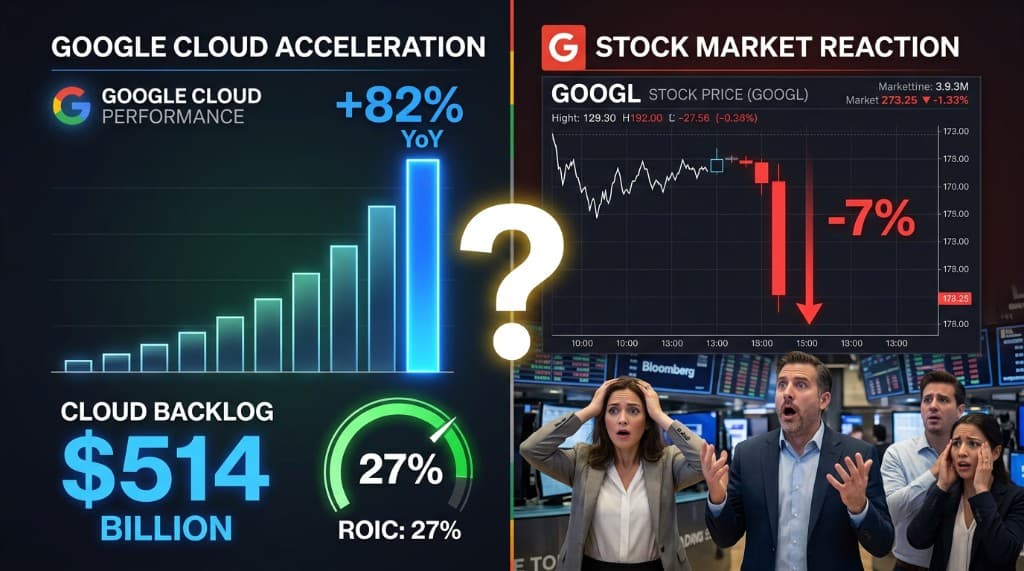
Cloud +82%, ROIC 27%, and a -7% Drop: Why the Market Got Alphabet Wrong
Alphabet reported Q2 2026 results that should have been celebrated: Google Cloud grew 82% year-over-year, beating expectations by more than 10 percentage points. The cloud backlog reached 514 billion dollars. EBIT margins expanded. The CEO confirmed that demand continues to exceed capacity. The stock fell 7%. The reason: the market focused exclusively on rising capital expenditure and a record equity raise, ignoring that Alphabet's return on invested capital is 27% — meaning every dollar deployed generates 1.27 dollars back. Fernando Sanchez argues this is precisely the short-termism that creates long-term opportunity.
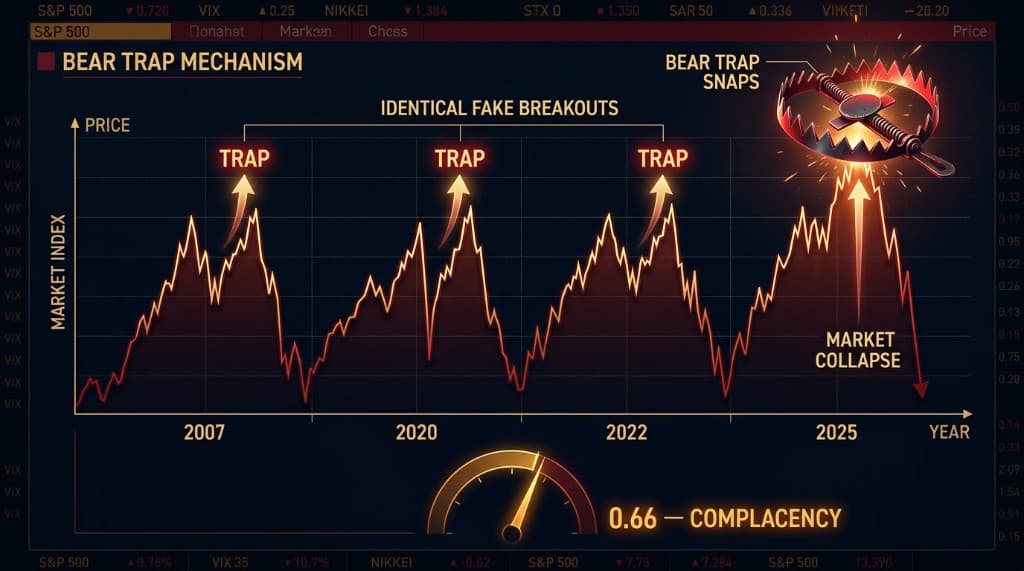
The Trap at the Top: Four Market Peaks, One Pattern — and What the Put-Call Ratio Is Telling Us Now
Jose Luis Cava has identified a recurring mechanical pattern at every major market top since 2007: a rally to a high, a corrective phase, and then a fake breakout to a marginally higher level that triggers buy stops and captures liquidity before a violent reversal. This pattern appeared in 2007, 2020, 2022, and 2025. The S&P 500 reached 7,620 in early June 2026 before entering a corrective phase. The put-call ratio currently sits at 0.66 — still in the complacency zone. If the index were to recover above 7,620 and then reverse sharply, that would confirm the trap. Until then, the corrective phase represents an opportunity window — not a signal to exit.

The Argentine Playbook: Merval +2600%, Gold +2900% — and Why the Same Logic Applies to You
Between August 2022 and mid-2026, Argentine savers who held the dollar saw their peso purchasing power grow 961%. Those who held the Merval stock index gained 2600%. Those who held gold gained 2900%. None of these assets performed well because the Argentine economy was thriving. They performed because the peso was being destroyed. Jose Luis Cava argues this same monetary degradation dynamic — fiscal deficits, debt expansion, currency debasement — is now operating in the United States at a slower pace. The implication: stocks, gold, and Bitcoin are not rising because the economy is great. They are rising because paper money is losing its value, and rational people are moving their savings into assets that cannot be printed.
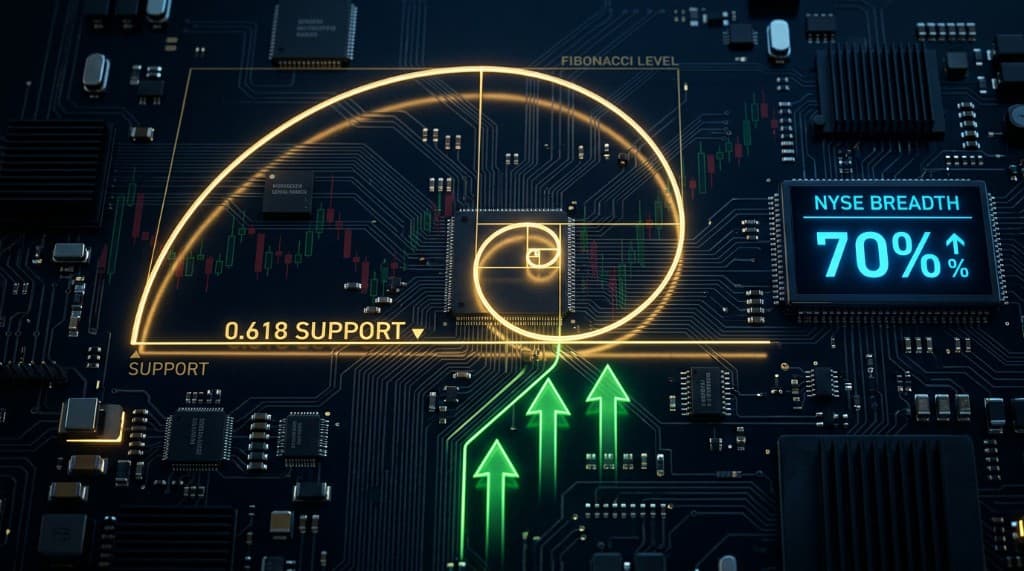
The 0.618 Signal: Why the Semiconductor Correction Is Fuel, Not Fire
The Philadelphia Semiconductor Index has corrected sharply from its June 2026 peak, and SK Hynix has returned to the exact level where its last major rally began on May 8. José Luis Cava identifies this as a Fibonacci 0.618 support — the golden ratio — where two independent technical structures converge on the same price. Meanwhile, NYSE breadth shows 70% of stocks above their 200-day moving average, the advance-decline line sits at all-time highs, and China has pivoted from withdrawing liquidity to injecting it. The conclusion: this is not a collapse. It is a mechanical cleanup of leveraged positions before the next wave.
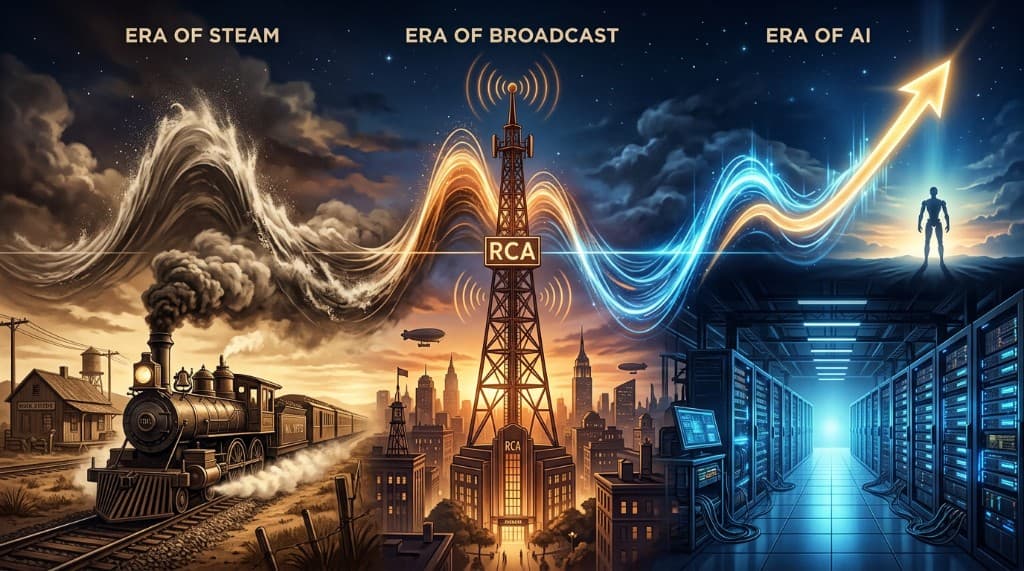
Railroads, Radio, and AI: Why the Last Wave Has Not Arrived Yet
Every major technology cycle in history followed the same pattern: infrastructure built ahead of demand, a vertical price rally, a catastrophic crash, and then decades of economic transformation driven by the technology that survived. The railroad bubble, RCA in the 1920s, and the dot-com collapse of 2000 each destroyed investors who entered at the peak while validating the long-term thesis. Jose Luis Cava argues that the current AI cycle — now approximately two years old — has not yet produced its final explosive wave. NVIDIA and AMD generate real cash. The cycle still has time. But the risk of entering at the top of that final wave will be real. The strategy: position now during the cleanup, and recognize the exit signals before universal optimism arrives.

From 4% to 22%: Why the Semiconductor Correction Is Technical — and Why 2027 Is the Opportunity of the Decade
Semiconductors have grown from 4% of the S&P 500 in the 2000s to 22% today. The SOX index rose 115% between late March and early July 2026. The current correction is not a fundamental deterioration — it is the mechanical expulsion of leveraged Korean retail investors and late-arriving fund managers who missed the move. José Luis Cava identifies specific entry zones for NVIDIA (164-170), AMD (409), Micron (712), and the SMH ETF (469-477). The deeper thesis: a robot consumes 50 times more semiconductors than an iPhone. As humanoid robotics scales from prototype to mass production in 2027, the structural demand case for semiconductors becomes independent of the AI data center cycle. Larry Fink of BlackRock calls it the beginning of the greatest expansion of global financial markets in history.
Why the Buffett Indicator Is Wrong at 234% — and the One Ratio That Actually Calls Market Tops
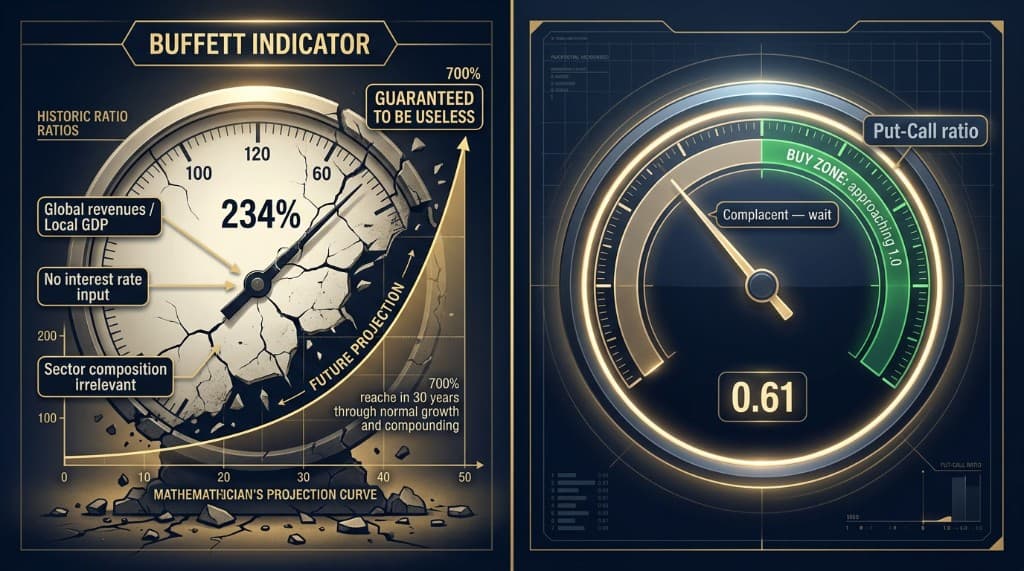
The Buffett Indicator — total US stock market value divided by US GDP — sits at an all-time high of 234%. Many analysts cite this as evidence of an imminent crash. José Luis Cava argues it is measuring the wrong things and will mathematically reach 700% to 800% in 30 years regardless of whether a bubble exists. The indicator that actually identifies genuine market extremes is the Put-Call ratio of the S&P 500. Currently at 0.60 to 0.61, it says the market is complacent but not yet at a buying opportunity. The real entry signal comes when that ratio approaches 1.0 — when fear returns and investors start buying protection again.

Why 40 Is Actually the Perfect Age to Start Investing: Buffett's 99.7% and the Math Nobody Shows You
Nine in ten Spaniards over 40 believe it is too late to build wealth through investing. Warren Buffett built 99.7% of his fortune after turning 50. A person starting at 40 with 10,000 euros and 600 euros per month, earning the stock market's historical average, reaches 530,000 euros by 60. If they learn to select the best companies within the index, that number exceeds one million. Fernando Sánchez explains why age is not the obstacle — and why the Spanish pension system is making this conversation urgent.

The Maradona Play: How Warsh Is Faking a Rate Hike — and Why Dark Pools Are Breaking Technical Analysis
Markets are pricing three Fed rate hikes. José Luis Cava argues they will get zero. The logic is borrowed from Diego Maradona: Kevin Warsh is publicly signaling hawkishness to maintain credibility inside the FOMC, while every data point — inflation expectations at 2.38%, falling energy prices, declining gold — removes the justification for actually raising rates. When the pivot comes, the setup for a pre-midterm rally is perfect. Separately, Cava identifies a structural problem that is quietly invalidating traditional technical analysis: dark pools now account for 30% to 40% of total market volume, and that volume is invisible to retail investors. The implications for how signals should be read — and why the options market has become more reliable than price-volume charts — are significant.
The Energy Trap, the China Paradox, and the One Number That Calls the Next Bull Run
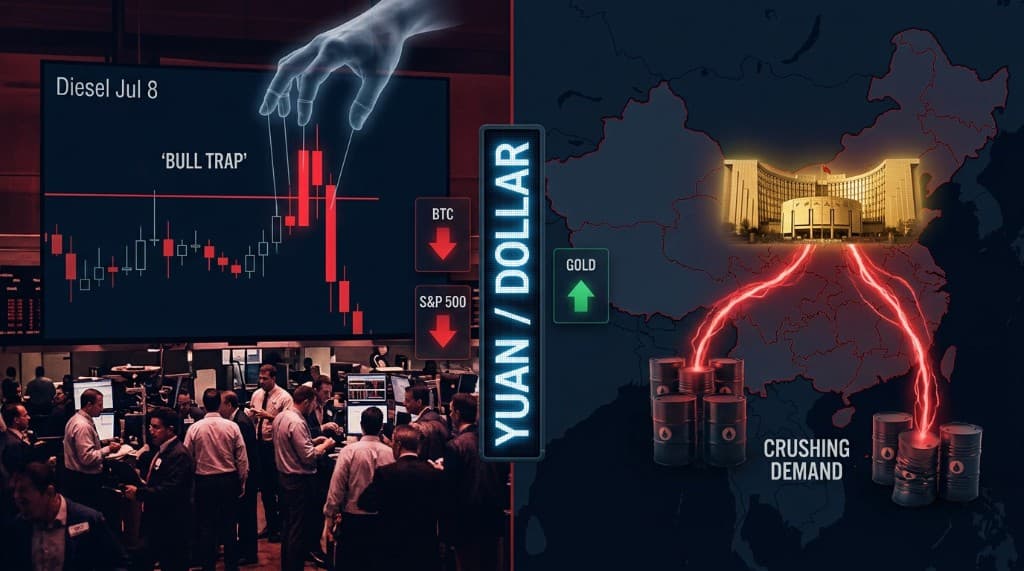
Markets are pricing in two Fed rate hikes for September based on rising diesel and gasoline prices. José Luis Cava argues both energy markets just executed textbook false breakouts — institutional traps designed to pull in retail buyers before prices fall. If he is right, the inflation narrative collapses, the rate hike case disappears, and the setup for a Q3-Q4 rally becomes clearer. The deeper story: the real source of global liquidity contraction is not the Fed, which is injecting a billion dollars a week into a system with over three trillion in bank reserves. It is the People's Bank of China, which has deliberately slowed its economy as part of a tacit agreement with Washington to suppress oil demand and contain energy prices. The Yuan is the only number that matters for timing the next move in Bitcoin, gold, and equities.
Burry's 42-Year Case Against Memory: Why Micron Is a Capital Destructor at Cycle Peak
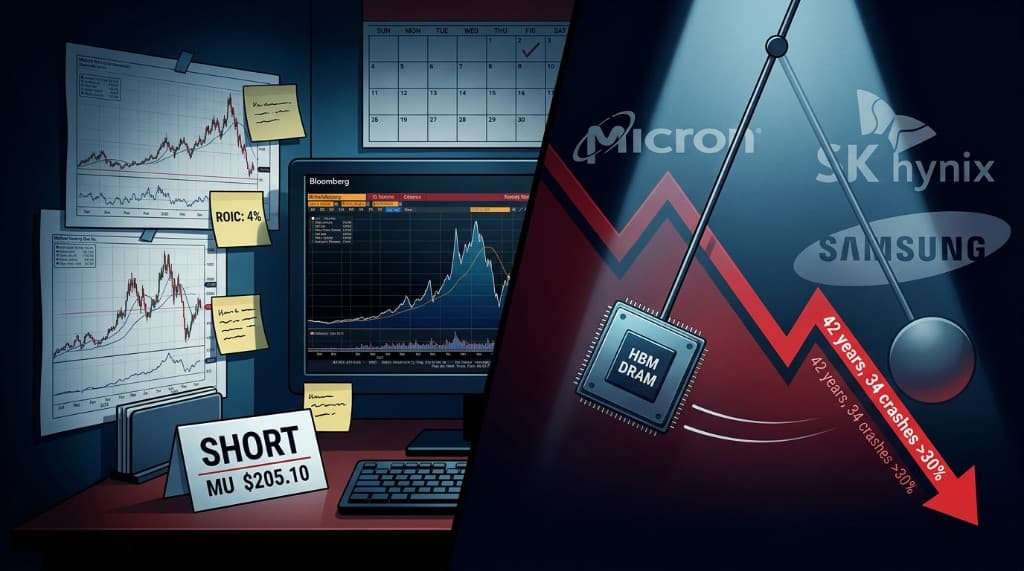
Michael Burry has opened short positions against Micron at $205.10, SOX, and Applied Materials — while going long Microsoft. His thesis is not a macro call. It is a data-driven argument built on 42 years of Micron's history: a median ROIC of 4% against a cost of capital above 10%, negative free cash flow in 48% of all quarters, 34 crashes of more than 30% in four decades, and a current valuation of 12x sales against a historical median of 2.2x. Fernando Sánchez explains why this cycle will not be different enough to matter — and why Micron's contribution of 16% of all S&P 500 earnings growth in 2026 makes this more than a sector call.
The Memory Crash, the KOSPI Sweep, and Why S&P 500 Is Heading to 8,000
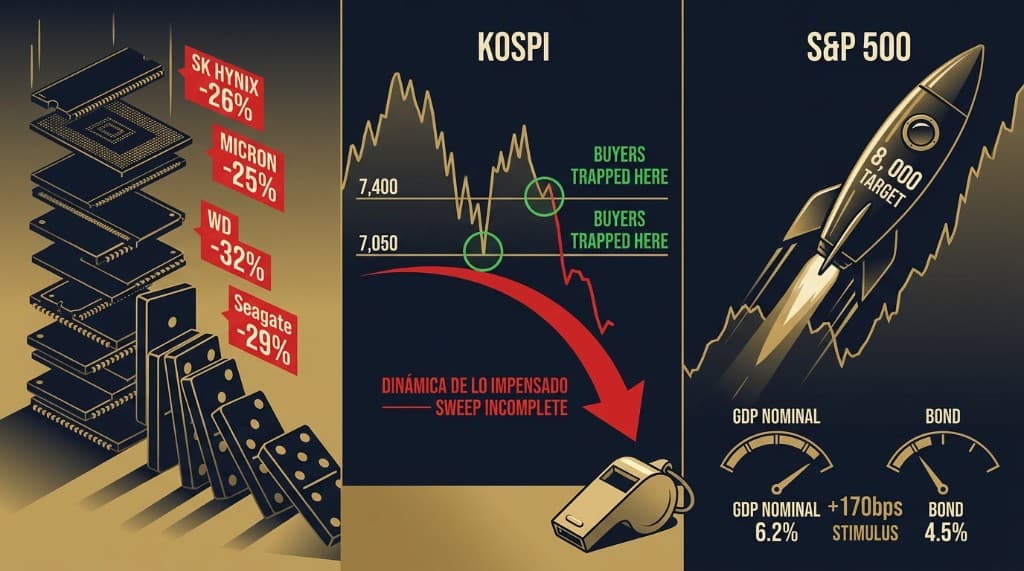
Fernando Sánchez documents the memory sector's two-week collapse: SK Hynix -26%, Western Digital -32%, Micron -25%, Seagate -29% from recent highs. José Luis Cava explains why it is not done yet, applying Dante Panzeri's football concept of 'the dynamics of the unexpected' to the KOSPI: the index must sweep every investor who entered since May — exhausting them psychologically — before a genuine bottom forms. Meanwhile, the S&P 500 case for 8,000 rests on a simple calculation: 6.2% nominal growth against a 4.5% bond yield implies 170 basis points of monetary stimulus that must find its way into equities.
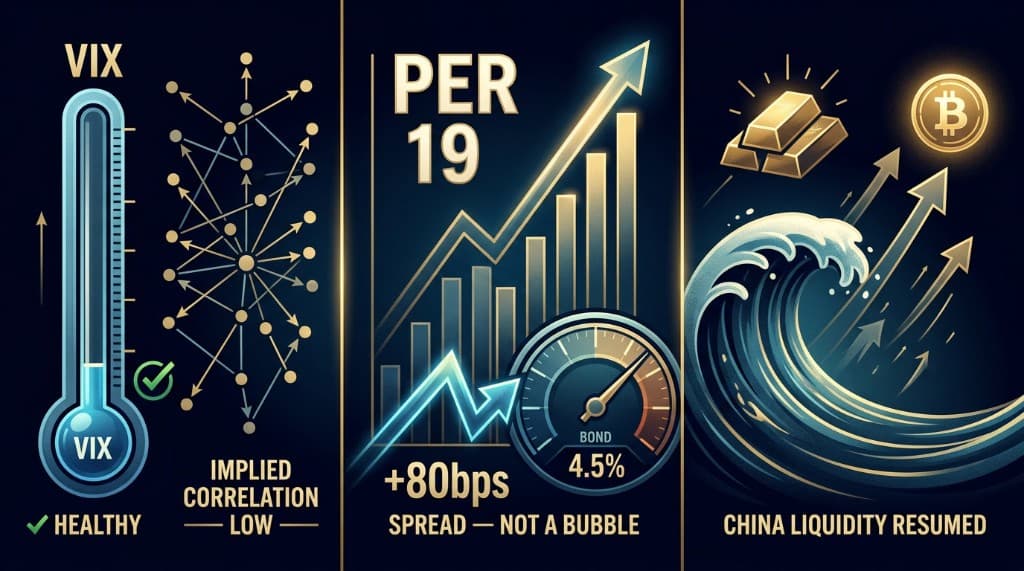
PER 19, GDP at 4%, and the Two Indicators That Actually Call Market Tops
José Luis Cava makes the quantitative case against the bubble narrative: the S&P 500 forward PER of 19 for end 2026 is cheap relative to a 4.5% bond yield, hyperscalers are investing 3% of US GDP in AI infrastructure, and US growth could approach 4% by 2027. More importantly, he identifies the two technical indicators that reliably signal genuine market tops — the VIX and implied correlation — and explains why both at current lows mean we are in a rotation, not a peak. Meanwhile, China has resumed liquidity injection after a temporary withdrawal, clearing the path for gold and Bitcoin to resume their structural uptrend.
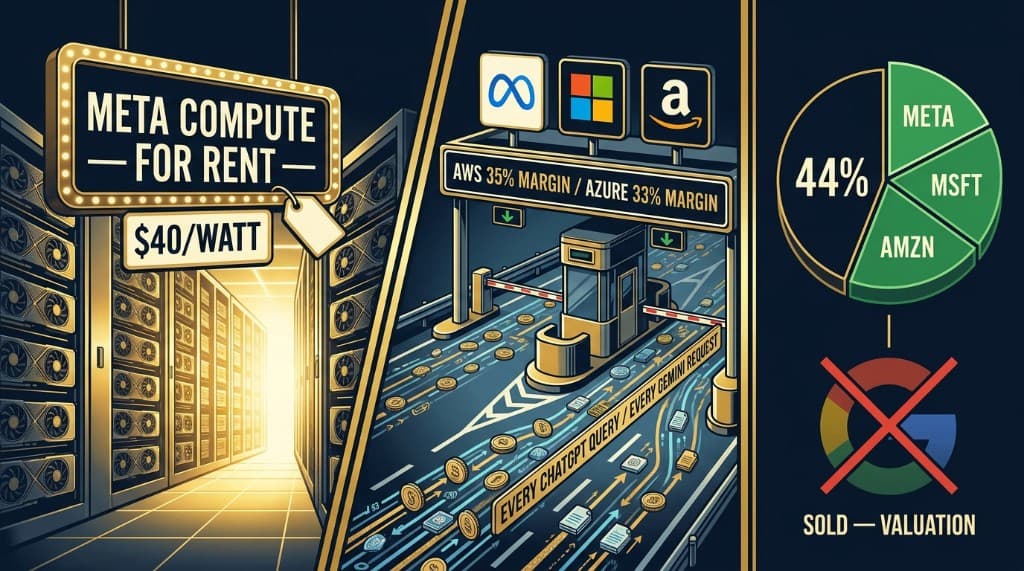
Meta Compute, the Toll Road, and Why Ackman Put 44% on Three Names
Two developments this week reframe the AI investment landscape. Fernando Sánchez analyzes Meta Compute — Meta's plan to sell or rent excess GPU capacity to third parties, turning already-spent capex into near-pure profit, with Morgan Stanley projecting $3-12 additional EPS by 2028 and stock targets of $872-$1,300+. Separately, Bill Ackman has concentrated 44% of his public portfolio in Meta, Microsoft, and Amazon — the 'toll road' owners of the AI era — while liquidating almost all of his Google position on valuation grounds. The hardware speculators are looking in the wrong direction.
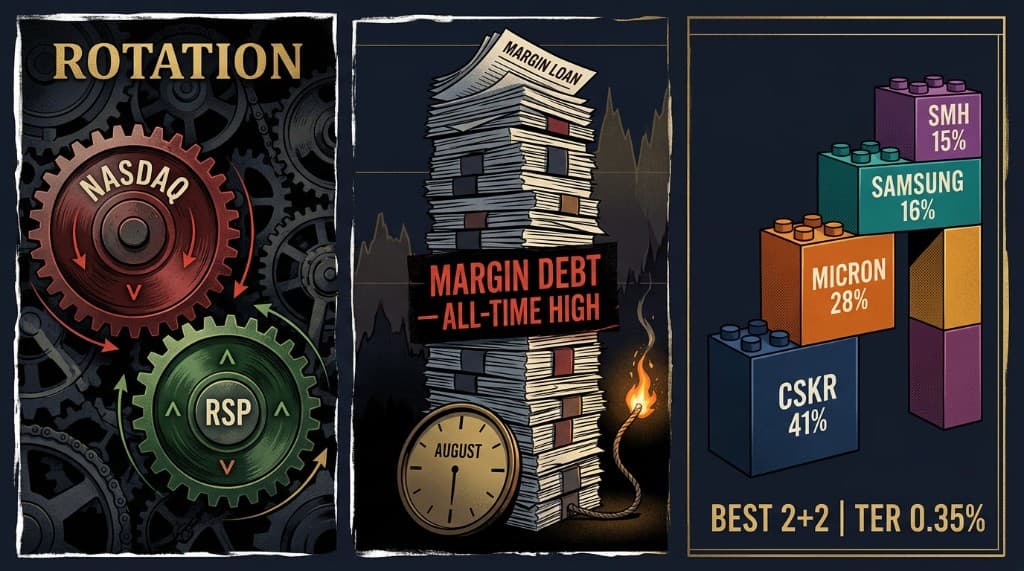
July's Rotation, the Margin Debt Warning, and the Best 2+2 Semiconductor Portfolio
José Luis Cava documents three distinct market dynamics converging in July 2026: an equal-weight S&P 500 closing higher while the Nasdaq falls confirms broad rotation, not narrow tech dependence. AAII bearish sentiment at 42% with bullish collapsing to 31% provides the contrarian signal for the month. But two structural risks loom — US margin debt at all-time highs and the SpaceX lock-up expiry — while the ECB's June rate hike is now confirmed as a policy error with oil down 25% since. For semiconductor investors, a 'Best 2+2' replication strategy captures 75% of the DRAM ETF return at half the cost.