Blog
Market analysis and congressional trading insights

The S&P Rally Is Likely a Trap: VIX at Lows, Call Squeeze, and a Market Top Forming in Plain Sight
Jose Luis Cava warns that the recent S&P 500 advance is not the start of a durable new uptrend — it is probably a trap, or the final upward wave before a sharp pullback. The VIX sits near lows (historically incompatible with a real bottom), AAII bears have fallen from 42% to 38% while bulls jumped from 31% to 37% in a week, hedge-fund buying is the strongest since 2008, semiconductors remain below their 50-day average, and the futures breakout of the June contracting triangle came on thin volume driven by a call squeeze — not fundamental demand. Add a 30-year yield break above 5.17% and Treasury liquidity engineering, and the setup looks like exhaustion dressed as recovery.

Leopold Aschenbrenner: 2,065% Returns, 4x Leverage, and a $16 Billion Forced Sale to Citadel
Fernando Sánchez reconstructs the rise and collapse of Leopold Aschenbrenner — the Columbia valedictorian who left OpenAI, raised $225 million on a viral AGI-by-2027 essay, ran a hedge fund at 4-to-1 leverage with up to 40% in a single name, grew AUM past $20 billion, then suffered a July 2026 margin call that forced a $16 billion fire sale to Ken Griffin's Citadel. The investor letter still claimed +80% year to date — almost entirely from an illiquid private Anthropic stake — while the public book was down roughly 90% in July. The moral: the market does not pay you for seeing the future. It pays you for remaining solvent when the future arrives.

Not a Bubble: The Leverage Cleanup Is Done — but Late August Still Has a Shakeout Coming
Jose Luis Cava argues August 2026 markets are healthy, not bubbly: the recent carnage was a purge of leveraged positions — epitomized by Leopold Aschenbrenner's forced sale to Citadel — not a fundamental collapse. On semiconductors, the SOXX hit 464 on July 29, almost exactly the May 4 origin level (469) Cava flagged on July 16. A rebound toward 565-580 is the near-term path. The catch: the second half of August likely brings a 'settling of accounts' that shakes out investors buying the bounce by inertia. With the S&P at a 22 PE, 10-year yields at 4.6%, earnings growth above 28%, and US GDP running near 4%, the base case remains a bull market through 2026-2027 after that final tactical dip.

320,000 Koreans Wiped Out: How Single-Stock Leveraged ETFs Turned an AI Rally Into a National Apology
Between December 2025 and June 2026, the KOSPI rose 130% and became the world's 6th-largest equity market — powered by SK Hynix and Samsung, which together exceed 50% of the index. In May, Korea's regulator approved 2x leveraged ETFs on individual stocks to stop capital fleeing to US products. Retail poured in $9.7 billion; at the June 22 peak those funds reached $52.5 billion in market value. Then memory corrected. SK Hynix fell 54%, Samsung 43%, the leveraged ETFs 75-80%, and the KOSPI 40%. Goldman estimates 1.2 million margin calls — 3.5% of Korea's adult population. More than 320,000 accounts were fully liquidated. The finance minister apologized to the nation. Fernando Sánchez's verdict: euphoria + extreme concentration + leverage + unprepared investors = guaranteed disaster.

SpaceX Before the August 6 Lock-Up: Short Covering, a False Breakdown, and the 119 Level That Matters
SpaceX is roughly 30% below its IPO price. Elon Musk calls it an opportunity — Jose Luis Cava warns that Musk is the largest shareholder with an incentive to talk the stock up. The real catalyst is August 6, when the first lock-up tranche doubles the freely tradable float. Cava's technical read is less apocalyptic than the float scare: ~33% of shares are short, a false breakdown below $107 on August 3 looks institutional, volume clusters between $105-$118, and a break above $119 opens a path toward $130. In the same video, he opens a separate critique of EIB financing to Morocco while Spain remains a major shareholder.

Zuckerberg Refuses to Rent Meta's Compute — Even at a Premium. That Is the Signal.
On Meta's Q2 earnings call, Mark Zuckerberg confirmed that other companies are offering to rent Meta's computing capacity at a considerable premium to what Meta pays for it. He rejected the offers. His reason matters more than the refusal: Meta believes selling intelligence built on that compute will generate significantly higher margins than selling the compute itself — and cloud compute is already a 35-45% EBIT-margin business. Fernando Sánchez reads this as a clear signal of the returns Zuckerberg expects from Meta's internal AI deployment.

The False Top Trap: HOPLA's Most Reliable Short Setup and What It Tells You About Market Structure
Jose Luis Cava calls it one of the 'evil tricks' in HOPLA's Playbook — a short-selling strategy with risk-reward ratios up to 1:8, built around a specific sequence: an accelerating trend, extreme bullish sentiment, a fake breakout above a key resistance level, and a three-wave flat pattern that sets up the ideal entry. Illustrated with the USD/JPY in April 2026, the logic extends to any liquid market including the Nasdaq and S&P 500. Understanding this pattern does not require you to sell short. It tells you when not to buy.

AWS +37%, a $1 Trillion Vision, and the CapEx the Market Keeps Getting Wrong
Amazon's Q2 2026 results delivered AWS growth of 36.7% — the fastest in 18 quarters — with a 39.4% operating margin and a $496 billion backlog growing at triple digits. CEO Andy Jassy declared that AWS can become a trillion-dollar annual revenue business, and that even with $220 billion in 2026 capital expenditure, Amazon will not have enough capacity to meet demand this year or next. The market reacted with a 15% stock price gain. The same CapEx that analysts once called reckless is now being validated quarter after quarter as the most rational capital allocation in corporate history.

The Engineered Crash: Margin Calls, Citadel, and 350,000 Liquidated Accounts That Created the Real Bottom
The late July 2026 crash in AI stocks and the KOSPI index was not a random market event. According to Jose Luis Cava's analysis, it was a carefully constructed mechanism: banks issued margin calls to leveraged AI funds, forcing panic selling; a false narrative about Federal Reserve rate hikes was spread to intensify the rout; oil was temporarily pushed to a key resistance level to feed inflation fears; and the result in South Korea was the forced liquidation of 350,000 leveraged accounts — 65% belonging to investors under 35 — in a decline steeper than the 2008 financial crisis. Understanding the mechanism is not conspiracy theorizing. It is understanding how institutional capital clears the path for the next advance.

France's Fiscal Dead End: Why the ECB Will Monetize the Deficit — and How Investors Defend Themselves
France's prime minister has called the country's fiscal outlook 'worrying and even serious.' The deficit sits near 6.5% of GDP — far above the government's 5% target for 2027 — and a hung parliament makes spending cuts politically impossible. Jose Luis Cava argues the only remaining path is more debt issuance, higher French yields, European market fragmentation, and eventual ECB monetization that accelerates euro degradation. The defense is the same playbook Argentine savers learned under Kirchnerism: recurrent allocation into S&P 500, gold, and Bitcoin — plus a tactical watchlist on oil refiners (CRAK, HF Sinclair, Marathon Petroleum).

The Chinese AI Efficiency Scare Is the Wrong Panic: Jevons' Paradox Says Cheaper Models Mean More Compute
Jose Luis Cava walks through a market simulation: a new Chinese AI model matches Anthropic and OpenAI quality at a fraction of the size. Nasdaq panics. Semiconductors crash. Investors conclude that trillions of data-center CapEx will never earn a return. Cava's answer is Jevons' Paradox — when a technology becomes cheaper and more efficient, usage expands into new tasks and new industries until total demand for the underlying resource rises, not falls. The investment implication is not to abandon AI infrastructure. It is to understand that efficient models unlock mass adoption — and that the long-term bid for compute may intensify, not disappear.

Why Your Tank Costs More Even When Oil Doesn't: The Refinery Market Futures Traders Cannot Control
Crude oil is trading at $84 a barrel — well below its recent peaks. Yet diesel and gasoline prices at the pump have risen sharply in recent weeks. The explanation reveals a split that most financial commentary ignores: crude oil and refined products are two different markets with different supply constraints. Paper oil futures can be manipulated. Physical diesel cannot. And a little-known Saudi terminal on the Red Sea may be the single most important energy infrastructure point on the planet right now.

Buffett's $31 Billion Bet: Why the Oracle Now Sees Alphabet as the Burlington Northern of the Digital Age
At 95, Warren Buffett confirmed that a $31 billion position in Alphabet — one of the largest in Berkshire Hathaway's history — was his personal decision, not his successors'. His reasoning dismantles the market's -7% reaction to Alphabet's Q2 earnings: the capital expenditure the market punished is exactly the infrastructure construction that Buffett has spent a lifetime buying. He is not buying a tech company. He is buying a toll road.

The Accounting Trick Behind China's Gold Rush: Trade Surpluses, IMF Pressure, and a Structural Bid the Market Is Missing
China tripled its gold purchases in the first half of 2026, from 0.5% to 1.5% of GDP. Most analysts attribute this to de-dollarization strategy. The real reason is more specific and more structural: Beijing is using gold imports as an accounting tool to hide a trade surplus that would otherwise trigger IMF sanctions and US Treasury designation as a currency manipulator. Understanding this mechanism reveals why Chinese institutional demand for gold is not speculative — it is a state obligation that will continue as long as the surplus exists.
Three Myths Keeping Investors Out of the Market — and Why the Rally to 2027 Is Still Intact
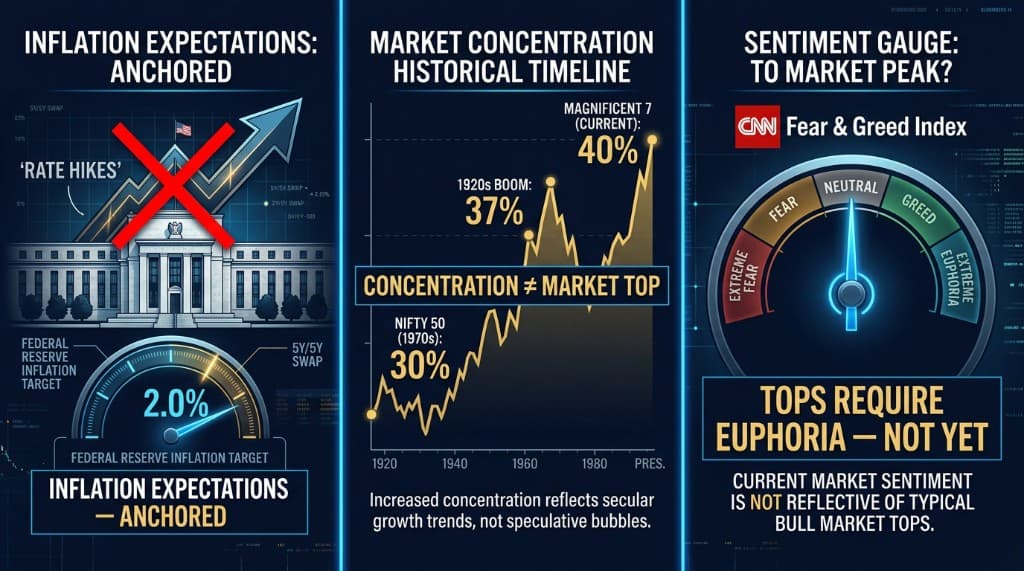
The market is currently pricing two to three Federal Reserve rate hikes for September 2026. But inflation expectations in the bond market have fallen back to 2% — the Fed's own target. HOPLA Finance argues that those rate hike expectations are significantly overpriced and will need to correct downward, creating a powerful tailwind for equities from late October 2026 through 2027. Meanwhile, two persistent narratives — that Magnificent 7 concentration signals a market top, and that neutral sentiment confirms one is imminent — are dismantled by historical evidence. Market tops require extreme euphoria. We are not there.